
Home / BGCSE / Business Studies

BGCSE Business Studies

Management, marketing, finance basics. Topic notes below are placeholders — swap in your own content topic by topic.

Topic 1

Business Organisation

The economic problem

Every economy, from a single household to a whole country, exists because wants — the things people would like to have — are effectively unlimited, while the resources available to satisfy them are limited, or scarce. Wants are different from needs: a need is something essential for survival (food, water, shelter), while a want is something that would be nice to have but is not essential for survival (a smartphone, a holiday). Businesses exist mainly to satisfy wants, and as incomes rise, wants tend to multiply faster than the resources available to satisfy them, which is why scarcity never disappears even in wealthy economies.

Because resources are scarce, every economic decision-maker — a consumer, a business, or a government — must make choices about how to use what is available. Choosing to use a resource one way always means it cannot be used another way, so every choice has a cost measured not in money but in what was given up. This is the opportunity cost of a decision: the value of the next best alternative sacrificed. A farmer who plants maize on a field gives up the beans that could have grown there instead; a government that builds a new clinic gives up the road it could have built with the same budget. Recognising opportunity cost is central to BGCSE Business Studies exam answers — examiners consistently reward candidates who can identify what was given up, not just what was chosen.

Three fundamental questions arise directly from the economic problem, and every economic system must answer them somehow: what to produce (which goods and services, and in what quantities), how to produce it (which combination of land, labour and capital, and which production method), and for whom to produce it (how the output gets distributed among the population). The way a society answers these three questions defines its economic system, covered next.

Economic systems

An economic system is the way a society organises its answers to the three basic economic questions. At one extreme sits the free market economy, where resources are privately owned and prices, set purely by the forces of demand and supply, decide what gets produced, how, and for whom — government intervention is kept to a minimum. Consumers "vote" with their money: if enough people want a good, its price rises, signalling producers to make more of it; if demand falls, price falls and producers switch resources elsewhere. This system rewards efficiency, innovation and consumer choice, since firms that fail to satisfy customers lose business to rivals. However, a pure free market can under-provide goods that are not profitable but are still socially valuable (such as street lighting or rural clinics), and it can produce large inequalities in income, since anyone without money to spend has no influence on what gets produced.

At the other extreme sits the command (planned) economy, where the government (or "the state") owns most resources and centrally decides what is produced, how, and for whom, often through a national plan. This can guarantee that basic needs are met for everyone regardless of income, and can direct resources quickly towards national priorities. Its weaknesses are well documented: without a price mechanism reflecting real demand, planners can misjudge what people actually want, leading to shortages of popular goods and surpluses of unwanted ones; and because firms do not compete for customers or profit, there is little incentive to cut costs, improve quality or innovate.

Almost every real economy, including Botswana's, is a mixed economy: a blend of the two extremes, in which markets are left to allocate most everyday goods and services, while government owns or regulates specific sectors, provides public goods that the market would under-supply (such as defence, most roads, and public education and health), and intervenes to correct problems the market creates on its own, such as pollution, monopoly power, or poverty.

FeatureFree market economyCommand economyMixed economy
Resource ownershipPrivate individuals and firmsThe stateBoth private and state ownership
What/how/for whom is decided byDemand and supply (the price mechanism)Central government planningMostly the market, with government intervention
Main advantageEfficient, innovative, gives consumers choiceBasic needs met for all; less inequalityBalances efficiency with fairness
Main disadvantageCan under-provide public goods; unequal outcomesSlow to respond to demand; little innovation incentiveGovernment intervention can be costly or inefficient

Production, specialisation and division of labour

Production is the process of combining resources to create goods and services that satisfy wants. Because no single person, business or country has an unlimited supply of every resource and every skill, most economic activity relies on specialisation: an individual, firm, region or country concentrates on producing the good or service it can produce most efficiently (at the lowest opportunity cost), and trades its surplus for the things other specialists produce more efficiently. A country rich in fertile land specialises in agriculture and imports manufactured goods; a worker who trains as an electrician specialises in wiring rather than also trying to be a plumber, mechanic and accountant.

Within a single firm's production process, specialisation takes the form of division of labour: a job is broken down into many small, repetitive tasks, and each worker is responsible for only one or two of them, rather than the whole product from start to finish. This is the principle behind the assembly line, and it raises output because workers become highly skilled and fast at their one task, less time is lost switching between different tools and jobs, and less training is needed for any single task. It has real costs, though: work can become monotonous and demotivating, workers become highly dependent on each other so that a breakdown or absence at one stage can halt the whole line, and workers who only ever perform one narrow task develop few transferable skills.

AdvantagesDisadvantages
Specialisation & division of labourHigher output and productivity; workers become highly skilled; less time lost switching tasks; less training required per taskMonotonous, demotivating work; heavy dependency between workers/stages; workers gain few transferable skills; a single breakdown can halt the whole process

Factors of production and stages of production

Every good or service, however simple, is produced by combining four factors of production. Land covers all natural resources used in production — not just farmland, but minerals, water and forests; its reward is rent. Labour is human effort, physical or mental, applied to production; its reward is wages. Capital is any man-made resource used to produce further goods and services rather than being consumed directly — machinery, tools, factory buildings; its reward is interest. Enterprise is the special factor supplied by the entrepreneur, who organises the other three factors, takes on the risk of the venture failing, and is rewarded (or punished) through profit (or loss).

Production itself is often described in three stages. The primary sector extracts raw materials directly from nature (farming, mining, fishing). The secondary sector manufactures those raw materials into finished or semi-finished goods (construction, textiles, food processing). The tertiary sector provides services rather than physical goods (retail, banking, tourism, transport). As an economy develops, employment typically shifts from primary towards secondary and then tertiary activity — a pattern visible in Botswana's own shift away from reliance on cattle and mining towards services such as tourism and finance.
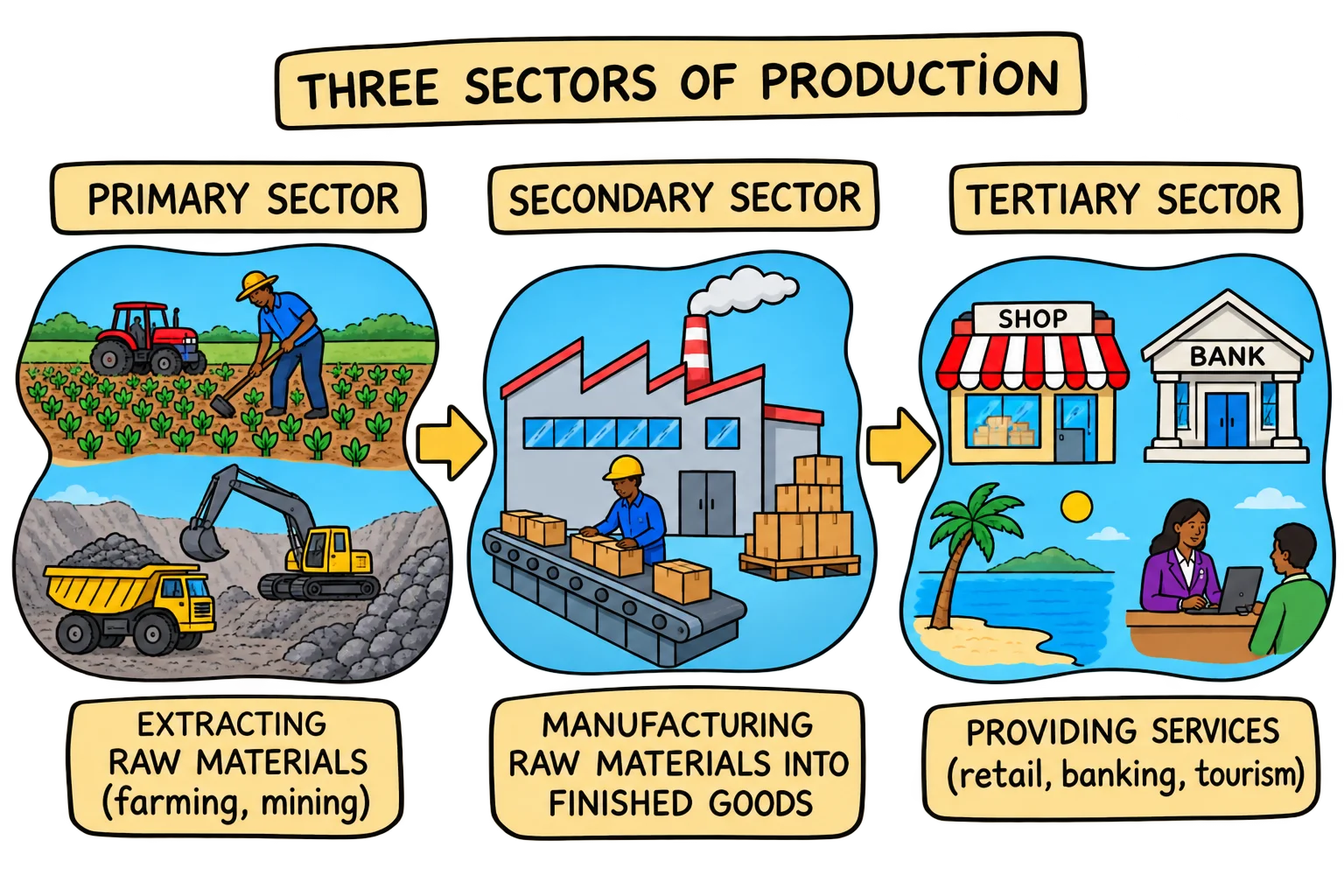
Diagram showing the three sectors of production: primary sector (extracting raw materials such as farming and mining), feeding into the secondary sector (manufacturing raw materials into finished goods), feeding into the tertiary sector (providing services such as retail, banking and tourism)
Output moves from the primary sector, through manufacturing in the secondary sector, to the services of the tertiary sector.

Business objectives, activity and stakeholders

A business activity is any activity that combines resources to produce goods or services, usually with the aim of satisfying customer wants at a profit. While profit maximisation is the most common objective, especially for private-sector firms, businesses may equally pursue survival (particularly when newly started or in a recession), growth in sales, market share or size, building a strong reputation for quality or ethics, or, for a charity or state enterprise, providing a service without necessarily seeking profit at all. Different objectives call for different strategies, and a business may shift its objective as it moves through different stages of its life.

A stakeholder is any individual or group with an interest in what a business does. Owners/shareholders want profit and a return on their investment; employees want fair pay, job security and good working conditions; customers want good quality, value for money and reliable service; suppliers want to be paid promptly and want repeat orders; the local community wants jobs and minimal environmental or social disruption; and government wants tax revenue and compliance with the law. These interests frequently conflict — for example, paying employees more (in their interest) reduces the profit available to shareholders (in their interest), and cutting costs to raise profit may mean laying off staff or cutting corners on environmental protection. A large part of exam-style analysis in this topic involves weighing up which stakeholder's interest a business decision favours, and at whose expense.

Business size, ownership and location

Business size is measured using several imperfect indicators — number of employees, value of annual output or sales, capital employed, and market share — and no single measure works for every business (a business with few, highly-paid employees might have huge output value, for instance), so examiners expect more than one measure to be considered together. Small businesses tend to offer flexibility and personal service and can react quickly to changes in customer taste, but usually cannot access the same finance, bargaining power or cost advantages as large firms. Large businesses can exploit economies of scale — falling average cost per unit as output rises, for example through bulk-buying discounts or spreading fixed costs over a larger volume — but tend to be less flexible and can suffer from poor internal communication as they grow (see Topic 5).

Location decisions weigh up the availability and cost of suitable land, access to labour with the right skills, proximity to raw materials and to the target market, the quality of transport and communication links, and government incentives such as grants or tax breaks for setting up in a targeted development area. A cement factory, tied to a heavy, low-value raw material, will typically locate near its quarry to minimise transport costs; a boutique clothing retailer will typically locate in a shopping mall with high customer footfall, since being close to customers matters more than being close to any raw material.

Business structureOwnershipLiabilityKey advantageKey disadvantage
Sole proprietorshipOne personUnlimitedCheap and simple to set up; full controlOwner personally liable for all debts
Partnership2 or more peopleUnlimited (unless limited partner)Shared capital, skills and workloadDisputes between partners; shared unlimited liability
Private limited companyShareholders (shares sold privately)LimitedOwners' personal assets protectedMore regulation; cannot sell shares to the public
Public limited companyShareholders (shares sold on a stock exchange)LimitedCan raise large amounts of capitalHeavy regulation; risk of takeover; ownership diluted
CooperativeMembersLimitedDemocratic, benefits shared among membersSlower decision-making; limited capital

Beyond these core forms, a franchise lets an entrepreneur (the franchisee) pay for the right to trade under an established brand, using its products, systems and marketing, in exchange for an initial fee and ongoing royalties — a lower-risk route into business than starting an entirely new brand, though it limits the franchisee's independence. The state may also own and run businesses directly: nationalisation brings a business into full state ownership, privatisation sells a state-owned business to private owners, and commercialisation keeps a business under state ownership but requires it to operate on profit-seeking, commercial lines rather than being subsidised indefinitely.

Government and business

Government intervenes in business activity for several distinct reasons. It protects consumers from unsafe products, false advertising and unfair contract terms; it protects employees through minimum wage law, health and safety regulation, and protection against unfair dismissal or discrimination; it controls monopoly power so that a dominant firm cannot exploit consumers through excessive prices or restricted output; and it regulates the harm businesses can do to the environment through pollution controls and licensing.

Government also pursues its own macroeconomic objectives on behalf of the whole country: low and stable inflation (a general, sustained rise in prices), high employment, sustainable economic growth (a rise in the total value of goods and services produced), and a healthy balance of payments (the relationship between what a country earns from exports and spends on imports). To pursue these objectives it uses fiscal policy — adjusting government spending and taxation — and monetary policy — mainly adjusting interest rates and the money supply, usually through the central bank. A cut in interest rates, for example, makes borrowing cheaper, encouraging businesses to invest and consumers to spend, which can boost growth and employment but risks pushing up inflation if the economy is already near full capacity.

Topic 2

Marketing

There's more where that came from ✨

Subscribe and get everything, for every topic:

✅ Full notes, every topic ✅ All exam questions ✅ Flashcards & diagrams ✅ New content first
Unlock full access →

Topic 3

Finance

There's more where that came from ✨

Subscribe and get everything, for every topic:

✅ Full notes, every topic ✅ All exam questions ✅ Flashcards & diagrams ✅ New content first
Unlock full access →

Topic 4

Human Resources

There's more where that came from ✨

Subscribe and get everything, for every topic:

✅ Full notes, every topic ✅ All exam questions ✅ Flashcards & diagrams ✅ New content first
Unlock full access →

Topic 5

Production & Operations

There's more where that came from ✨

Subscribe and get everything, for every topic:

✅ Full notes, every topic ✅ All exam questions ✅ Flashcards & diagrams ✅ New content first
Unlock full access →

Flashcards

Key Terms

60 cards covering every topic below.

TermOpportunity cost
DefinitionThe alternative that is given up as a result of choosing another alternative.
TermEconomic system
DefinitionThe way a country uses its scarce resources to satisfy the needs and wants of its people — free market, planned, or mixed.
TermSpecialisation
DefinitionWhen an individual, business or country concentrates on doing one job or producing one product.
TermDivision of labour
DefinitionThe breaking down of a job into smaller tasks so that each employee performs a particular task.
TermValue added
DefinitionThe improvement made to a product at each stage of production to make it more appealing to consumers.
TermHorizontal integration
DefinitionWhen a business merges with or takes over another business in the same industry, at the same stage of production.
TermVertical integration
DefinitionWhen a business merges with or takes over another business in the same industry, but at a different stage of production — forward (towards the consumer) or backward (towards raw materials).
TermConglomerate integration
DefinitionAlso called diversification — when a firm merges with or takes over a firm in a completely different industry.
TermUnincorporated business unit
DefinitionA business with no separate legal entity from its owner(s) — the owner bears full responsibility for its actions, e.g. sole proprietorship, partnership.
TermIncorporated business unit
DefinitionA legal entity separate and distinct from its owners, with the right to sue and be sued, e.g. limited companies, closed corporations.
TermLimited liability
DefinitionWhere a shareholder's responsibility for company debts is limited to the amount of capital they invested — their personal assets are not at risk.
TermFranchising
DefinitionWhen a company (the franchisor) allows someone (the franchisee) to buy the right to trade under its name, using its products, techniques and support.
TermPrivatisation, nationalisation & commercialisation
DefinitionPrivatisation sells a state enterprise to private owners; nationalisation brings a private business into state ownership; commercialisation turns a state-owned entity into a profit-making one.
1 / 13

Click/tap the card to flip it

TermMarket segmentation
DefinitionBreaking a market down into sub-groups of customers who share similar characteristics.
TermNiche marketing
DefinitionTargeting a small, specialised segment of a much larger market.
TermPrimary research
DefinitionCollecting raw, first-hand data that has never been collected before, e.g. by questionnaire, interview or observation.
TermSecondary research
DefinitionCollecting data using sources that already exist and were gathered for another purpose.
TermProduct life cycle
DefinitionThe stages a product passes through from launch to decline: introduction, growth, maturity, saturation and decline.
TermBranding
DefinitionGiving a product a name or mark that differentiates it from other products, building brand loyalty and brand image.
TermPenetration pricing
DefinitionSetting a lower price than competitors to gain entry into a market quickly.
TermPrice skimming
DefinitionSetting a high price for a new, innovative product before competitors enter the market.
TermAIDA model
DefinitionA model for designing adverts: Attention, Interest, Desire, Action.
TermChannel of distribution
DefinitionThe route by which a product passes from the producer to the final consumer, e.g. producer → wholesaler → retailer → consumer.
TermGlobalisation
DefinitionWorldwide interaction between businesses, people and economies, making the world one large market rather than separate national markets.
1 / 11

Click/tap the card to flip it

TermGross profit
DefinitionSales revenue minus cost of sales — profit before other expenses are deducted.
TermNet profit
DefinitionThe profit remaining after every business expense has been deducted from gross profit.
TermWorking capital
DefinitionThe money used for the day-to-day running of the business — current assets minus current liabilities.
TermLiquidity ratio
DefinitionA ratio measuring a business's ability to pay its short-term, day-to-day operating costs.
TermRetained profit
DefinitionAn internal source of finance — profit ploughed back into the business rather than paid out to the owner.
TermOverdraft
DefinitionBorrowing more money than is available in a bank account — a flexible but short-term, expensive external source of finance.
TermMortgage
DefinitionA loan secured against an asset (usually property), giving large amounts at relatively low interest but risking repossession if unpaid.
TermDebenture
DefinitionMoney loaned to a company by the public, repaid with interest — does not carry voting rights, so ownership control is unaffected.
TermShare
DefinitionA unit of a limited company's capital — raises large sums without repayment, but dilutes ownership and control.
TermStock exchange
DefinitionA market where shares are bought and sold.
TermCash flow forecast
DefinitionAn estimate of future cash inflow and outflow of a business over a period of time.
1 / 11

Click/tap the card to flip it

TermOrganisational structure
DefinitionThe levels of management and division of responsibility within an organisation.
TermChain of command
DefinitionThe structure that allows instructions to pass down from senior management to lower levels.
TermSpan of control
DefinitionThe number of subordinates working directly under one manager.
TermDelegation
DefinitionGiving subordinates the authority to perform a task, though the manager remains accountable if it is done badly.
TermCentralisation vs. decentralisation
DefinitionCentralisation keeps decisions with top management; decentralisation gives lower levels of management the authority to decide.
TermMaslow's hierarchy of needs
DefinitionA theory of motivation ranking human needs from physiological and safety needs up to esteem and self-actualisation.
TermJob enrichment vs. job enlargement
DefinitionJob enrichment adds tasks requiring more skill and responsibility; job enlargement adds extra tasks of a similar level without extra responsibility.
TermAutocratic leadership
DefinitionA style where the leader makes decisions alone, without consulting employees.
TermDemocratic leadership
DefinitionA style where employees are consulted and involved in decision-making.
TermLaissez-faire leadership
DefinitionA style where the leader sets objectives, then leaves employees free to decide how to meet them.
TermTrade union
DefinitionA group of workers who join together to protect their rights and interests, such as pay and working conditions.
TermCollective bargaining
DefinitionNegotiation between a trade union and an employer over pay and working conditions.
TermConciliation vs. arbitration
DefinitionConciliation uses an outsider to help both sides communicate; arbitration has an outsider pass a binding judgment both sides must accept.
1 / 13

Click/tap the card to flip it

TermJob production
DefinitionMaking a single product at a time according to a customer's specific order.
TermBatch production
DefinitionMaking a certain quantity or group of identical goods at a time before switching to another product.
TermMass/flow production
DefinitionMaking large volumes of standardised goods in a continuous process.
TermAutomation
DefinitionThe use of machinery during the production process, raising output and quality but cutting jobs.
TermJust-in-time (JIT)
DefinitionA production system where raw materials are delivered only when needed, avoiding the business holding stock.
TermQuality control vs. quality assurance
DefinitionQuality control checks for rejects at the end of production; quality assurance builds quality standards into design, materials and delivery throughout.
TermBreak-even point
DefinitionThe level of sales where total revenue equals total costs — calculated as fixed costs ÷ contribution.
TermContribution
DefinitionSelling price per unit minus variable cost per unit.
TermEconomies of scale
DefinitionThe cost advantages a firm gains as it increases in size, e.g. purchasing, technical, financial and managerial economies.
TermDiseconomies of scale
DefinitionThe disadvantages, such as poor communication and low morale, that a firm incurs from becoming too large.
TermInvention vs. innovation
DefinitionInvention is the creation of a new product; innovation is producing new solutions/improvements, usually applying an invention to solve a problem.
TermResearch and development (R&D)
DefinitionInvestigating customer needs to develop ideas for improving existing products or creating new ones.
1 / 12

Click/tap the card to flip it

Business Organisation

1
4 marks
Explain two benefits of a planned economic system to a country's citizens.
Model answer Any two of: goods and services are affordable, since prices are regulated by the government, which helps improve citizens' standard of living; the needs of the population are prioritised, since government allocates resources to meet them directly; environmental problems are taken care of, since profit is not the only motive guiding production; there are no private monopolies exploiting consumers, since businesses are state-owned.
2
6 marks
A clothing manufacturer takes over another clothing manufacturer in the same country. (a) Name this type of integration. (b) Explain two advantages this brings the combined business.
Model answer (a) Horizontal integration — the two businesses are in the same industry and at the same stage of production. (b) Any two of: more market, since customers who previously bought from either business now buy from the combined entity; more profit, since the combined business sells more; fewer competitors, since two rivals have become one — though the business risks becoming too large to manage well or forming a monopoly that becomes inefficient through lack of competition.
3
6 marks
Distinguish between an incorporated and an unincorporated business unit, referring to legal identity, owner liability, and the right to sue or be sued.
Model answer An unincorporated business unit (e.g. a sole proprietorship or partnership) has no separate legal identity from its owner(s) — the owner's personal possessions are at risk, and the business itself has no right to sue or be sued in its own name. An incorporated business unit (e.g. a limited company or closed corporation) is a legal entity separate and distinct from its owners — the owners' personal assets are protected, and the business itself can sue or be sued.
4
4 marks
Explain two reasons why the Botswana government might choose to privatise a state-owned corporation.
Model answer Any two of: to improve efficiency through the competition that private ownership brings; to generate revenue for the government from the sale, which can be used to develop the country; to improve the quality of goods and services offered, since a profit-driven private owner has an incentive to satisfy customers; to widen the range of goods and choices available to consumers.

Topic 2

MarketingMarketing

There's more where that came from ✨

Subscribe and get everything, for every topic:

✅ Full notes, every topic ✅ All exam questions ✅ Flashcards & diagrams ✅ New content first
Unlock full access →

Topic 3

FinanceFinance

There's more where that came from ✨

Subscribe and get everything, for every topic:

✅ Full notes, every topic ✅ All exam questions ✅ Flashcards & diagrams ✅ New content first
Unlock full access →

Topic 4

Human ResourcesHuman Resources

There's more where that came from ✨

Subscribe and get everything, for every topic:

✅ Full notes, every topic ✅ All exam questions ✅ Flashcards & diagrams ✅ New content first
Unlock full access →

Topic 5

Production & OperationsProduction & Operations

There's more where that came from ✨

Subscribe and get everything, for every topic:

✅ Full notes, every topic ✅ All exam questions ✅ Flashcards & diagrams ✅ New content first
Unlock full access →

Mock Exams & Past Papers

Full Papers

Two full-length mock papers in the BGCSE Business Studies exam style, drawing on every topic above. Work through each paper under timed conditions on your own paper, then reveal each answer to mark yourself.

Paper 1 — Multiple Choice

Time allowed: 45 minutes  •  Total marks: 20

Instructions

  • Answer all 20 questions.
  • Each question carries 1 mark. Choose the single best answer.
1
1 mark
The situation that arises because wants are unlimited but resources are limited is called:
  • A.Opportunity cost
  • B.The economic problem
  • C.Specialisation
  • D.Division of labour
2
1 mark
An economic system where the factors of production are owned by private individuals is a:
  • A.Planned economy
  • B.Free market economy
  • C.Command economy
  • D.Nationalised economy
3
1 mark
A bakery merging with another bakery is an example of:
  • A.Backward vertical integration
  • B.Forward vertical integration
  • C.Horizontal integration
  • D.Conglomerate integration
4
1 mark
A business that has a separate legal identity from its owners, with the right to sue or be sued, is described as:
  • A.Unincorporated
  • B.Incorporated
  • C.Nationalised
  • D.Privatised
5
1 mark
Turning a state-owned entity into a profit-making business, while it remains state owned, is called:
  • A.Privatisation
  • B.Nationalisation
  • C.Commercialisation
  • D.Integration
6
1 mark
Dividing a total market into smaller groups of customers who share similar characteristics is known as:
  • A.Niche marketing
  • B.Market segmentation
  • C.Market research
  • D.Branding
7
1 mark
Setting a high price for a new, innovative product before competitors enter the market is called:
  • A.Penetration pricing
  • B.Price skimming
  • C.Competitive pricing
  • D.Cost-plus pricing
8
1 mark
In the AIDA model, the letter "D" stands for:
  • A.Delivery
  • B.Discount
  • C.Desire
  • D.Distribution
9
1 mark
Profit ploughed back into a business rather than paid out to the owner is an example of:
  • A.Internal finance
  • B.External finance
  • C.A debenture
  • D.A mortgage
10
1 mark
A loan to a company that does not carry voting rights, so it does not affect ownership control, is a:
  • A.Share
  • B.Debenture
  • C.Grant
  • D.Overdraft
11
1 mark
Break-even output is calculated as:
  • A.Fixed costs × contribution
  • B.Fixed costs ÷ contribution
  • C.Total costs ÷ selling price
  • D.Variable costs ÷ fixed costs
12
1 mark
A production method that makes a single, unique product to a specific customer order is:
  • A.Job production
  • B.Batch production
  • C.Mass/flow production
  • D.Automated production
13
1 mark
A cost advantage gained from being able to negotiate discounts when buying raw materials in bulk is a:
  • A.Diseconomy of scale
  • B.Technical economy of scale
  • C.Purchasing economy of scale
  • D.Managerial economy of scale
14
1 mark
The number of subordinates working directly under one manager is called the:
  • A.Chain of command
  • B.Span of control
  • C.Hierarchy
  • D.Delegation
15
1 mark
A leadership style where the leader makes all decisions alone, without consulting employees, is:
  • A.Autocratic
  • B.Democratic
  • C.Laissez-faire
  • D.Charismatic
16
1 mark
Adding tasks that require more skill and responsibility to a worker's job is called:
  • A.Job rotation
  • B.Job enlargement
  • C.Job enrichment
  • D.Delegation
17
1 mark
A resolution method where an independent outsider passes a binding judgment that both sides must accept is:
  • A.Conciliation
  • B.Arbitration
  • C.Collective bargaining
  • D.A go-slow
18
1 mark
A production system where raw materials are delivered only when needed, avoiding the business holding stock, is:
  • A.Quality assurance
  • B.Batch production
  • C.Just-in-time (JIT)
  • D.Total quality management
19
1 mark
Balance of payments is best described as:
  • A.The general increase in prices of all commodities
  • B.The difference between a country's total exports and total imports
  • C.The value of goods produced in a country per year
  • D.The rate of unemployment in a country
20
1 mark
Selling a product's rights, techniques and trade name to another operator to run their own outlet is:
  • A.A joint venture
  • B.A closed corporation
  • C.Franchising
  • D.A merger

Paper 2 — Structured Questions

Time allowed: 2 hours  •  Total marks: 80

Instructions

  • Answer all questions on your own paper.
  • Where a question asks you to discuss or evaluate, give a clear positive point, a clear negative point, and a justified conclusion.
1
14 marks
Mmatli Furniture (Pty) Ltd is a medium-sized business manufacturing beds and baby cots in Botswana, employing 30 workers. Before beginning production, the business calculated its fixed costs, variable costs and expected revenue.
  1. Explain two factors that could be used to measure the size of Mmatli Furniture (Pty) Ltd. (4 marks)
  2. Mmatli Furniture has fixed costs of P45,000 per month. Each bed sells for P5,500 and costs P3,000 in variable costs to produce. Calculate the number of beds it must sell each month to break even. (4 marks)
  3. Explain two economies of scale Mmatli Furniture could enjoy if it grows into a large-scale manufacturer. (6 marks)
Model answer
  1. Any two of: number of employees (30 places it as medium-sized rather than large); capital employed in machinery and premises; sales turnover/level of output; profit made. Each factor should be explained and linked to how it distinguishes a medium business from a small or large one.
  2. Contribution per bed = 5,500 − 3,000 = 2,500. Break-even output = 45,000 ÷ 2,500 = 18 beds per month.
  3. Any two of: purchasing economies (bulk-buying wood and materials more cheaply); technical economies (affording large, efficient machinery); financial economies (borrowing more cheaply as a larger, lower-risk business); managerial economies (affording specialist managers in production, finance and marketing).
2
14 marks
Botlhe Dairy (Pty) Ltd currently sells milk only within Botswana. The Managing Director makes all major decisions alone, without consulting other managers, which has caused friction with senior staff.
  1. Identify the leadership style used by the Managing Director and explain one situation in which it could be appropriate. (4 marks)
  2. Discuss one advantage and one disadvantage of this leadership style for Botlhe Dairy. (6 marks)
  3. Would you recommend Botlhe Dairy switch to a democratic leadership style? Justify your answer. (4 marks)
Model answer
  1. Autocratic leadership — appropriate when decisions must be made very quickly, such as during a crisis, or when the workforce is inexperienced and needs clear direction rather than being consulted.
  2. Advantage: decisions can be made and implemented very quickly since no time is lost consulting others. Disadvantage: skilled, experienced senior staff can feel undervalued and demotivated when their expertise and opinions are ignored, which is consistent with the friction described.
  3. Yes — a democratic style would likely reduce the friction described, since consulting senior managers before deciding would make them feel valued and would draw on their expertise, improving both morale and the quality of decisions, even though it would slow decision-making down somewhat; the trade-off is worthwhile given how experienced the affected staff are.
3
14 marks
Kgotla Crafts sells handmade baskets to tourists. The owner is considering two sources of finance to buy new equipment: a bank loan or issuing shares by converting to a private limited company.
  1. Explain one advantage and one disadvantage of financing the equipment with a bank loan. (6 marks)
  2. Explain one advantage and one disadvantage of raising the money by issuing shares instead. (6 marks)
  3. State which source you would recommend. (2 marks)
Model answer
  1. Advantage: a bank loan provides the money quickly without giving up any ownership of the business. Disadvantage: it is costly, since it must be repaid with interest regardless of how the business performs, and missing repayments risks damaging the business's credit standing or losing any asset used as security.
  2. Advantage: money raised through shares does not have to be repaid, and a larger sum can potentially be raised by selling shares to multiple investors. Disadvantage: converting to a private limited company dilutes the owner's control, since new shareholders gain a say in the business, and shareholders will expect a share of future profits as dividends.
  3. A bank loan is likely more suitable for a single piece of equipment, since it keeps full ownership and control with the current owner and avoids permanently giving away a share of future profits for what is a one-off purchase.
4
14 marks
Tirelo Textiles produces school uniforms and has recently faced increased competition from imported uniforms sold at lower prices.
  1. Explain two pricing strategies Tirelo Textiles could use to respond to this competition. (8 marks)
  2. Explain one non-price method Tirelo Textiles could use to compete instead of, or alongside, changing price. (6 marks)
Model answer
  1. Competitive pricing — setting a price similar to (or just below) the imported uniforms, directly matching the competition to retain price-sensitive customers, though this reduces Tirelo's profit margin per unit. Alternatively, penetration pricing on new lines — setting a deliberately low price to win back market share quickly, accepting lower short-term revenue in exchange for volume and customer loyalty.
  2. Branding and quality assurance — Tirelo could emphasise that its uniforms are locally made, more durable, or better fitted than imports, building brand loyalty so that customers are willing to pay a little more rather than switch to a cheaper, lower-quality import; this shifts competition away from price alone and towards perceived value.