 Morutabana / study
Topic 1
Business Organisation
The economic problem
Every economy, from a single household to a whole country, exists because wants — the things people would like to have — are effectively unlimited, while the resources available to satisfy them are limited, or scarce. Wants are different from needs: a need is something essential for survival (food, water, shelter), while a want is something that would be nice to have but is not essential for survival (a smartphone, a holiday). Businesses exist mainly to satisfy wants, and as incomes rise, wants tend to multiply faster than the resources available to satisfy them, which is why scarcity never disappears even in wealthy economies.
Because resources are scarce, every economic decision-maker — a consumer, a business, or a government — must make choices about how to use what is available. Choosing to use a resource one way always means it cannot be used another way, so every choice has a cost measured not in money but in what was given up. This is the opportunity cost of a decision: the value of the next best alternative sacrificed. A farmer who plants maize on a field gives up the beans that could have grown there instead; a government that builds a new clinic gives up the road it could have built with the same budget. Recognising opportunity cost is central to BGCSE Business Studies exam answers — examiners consistently reward candidates who can identify what was given up, not just what was chosen.
Three fundamental questions arise directly from the economic problem, and every economic system must answer them somehow: what to produce (which goods and services, and in what quantities), how to produce it (which combination of land, labour and capital, and which production method), and for whom to produce it (how the output gets distributed among the population). The way a society answers these three questions defines its economic system, covered next.
Economic systems
An economic system is the way a society organises its answers to the three basic economic questions. At one extreme sits the free market economy, where resources are privately owned and prices, set purely by the forces of demand and supply, decide what gets produced, how, and for whom — government intervention is kept to a minimum. Consumers "vote" with their money: if enough people want a good, its price rises, signalling producers to make more of it; if demand falls, price falls and producers switch resources elsewhere. This system rewards efficiency, innovation and consumer choice, since firms that fail to satisfy customers lose business to rivals. However, a pure free market can under-provide goods that are not profitable but are still socially valuable (such as street lighting or rural clinics), and it can produce large inequalities in income, since anyone without money to spend has no influence on what gets produced.
At the other extreme sits the command (planned) economy, where the government (or "the state") owns most resources and centrally decides what is produced, how, and for whom, often through a national plan. This can guarantee that basic needs are met for everyone regardless of income, and can direct resources quickly towards national priorities. Its weaknesses are well documented: without a price mechanism reflecting real demand, planners can misjudge what people actually want, leading to shortages of popular goods and surpluses of unwanted ones; and because firms do not compete for customers or profit, there is little incentive to cut costs, improve quality or innovate.
Almost every real economy, including Botswana's, is a mixed economy: a blend of the two extremes, in which markets are left to allocate most everyday goods and services, while government owns or regulates specific sectors, provides public goods that the market would under-supply (such as defence, most roads, and public education and health), and intervenes to correct problems the market creates on its own, such as pollution, monopoly power, or poverty.
| Feature | Free market economy | Command economy | Mixed economy |
|---|---|---|---|
| Resource ownership | Private individuals and firms | The state | Both private and state ownership |
| What/how/for whom is decided by | Demand and supply (the price mechanism) | Central government planning | Mostly the market, with government intervention |
| Main advantage | Efficient, innovative, gives consumers choice | Basic needs met for all; less inequality | Balances efficiency with fairness |
| Main disadvantage | Can under-provide public goods; unequal outcomes | Slow to respond to demand; little innovation incentive | Government intervention can be costly or inefficient |
Production, specialisation and division of labour
Production is the process of combining resources to create goods and services that satisfy wants. Because no single person, business or country has an unlimited supply of every resource and every skill, most economic activity relies on specialisation: an individual, firm, region or country concentrates on producing the good or service it can produce most efficiently (at the lowest opportunity cost), and trades its surplus for the things other specialists produce more efficiently. A country rich in fertile land specialises in agriculture and imports manufactured goods; a worker who trains as an electrician specialises in wiring rather than also trying to be a plumber, mechanic and accountant.
Within a single firm's production process, specialisation takes the form of division of labour: a job is broken down into many small, repetitive tasks, and each worker is responsible for only one or two of them, rather than the whole product from start to finish. This is the principle behind the assembly line, and it raises output because workers become highly skilled and fast at their one task, less time is lost switching between different tools and jobs, and less training is needed for any single task. It has real costs, though: work can become monotonous and demotivating, workers become highly dependent on each other so that a breakdown or absence at one stage can halt the whole line, and workers who only ever perform one narrow task develop few transferable skills.
| Advantages | Disadvantages | |
|---|---|---|
| Specialisation & division of labour | Higher output and productivity; workers become highly skilled; less time lost switching tasks; less training required per task | Monotonous, demotivating work; heavy dependency between workers/stages; workers gain few transferable skills; a single breakdown can halt the whole process |
Factors of production and stages of production
Every good or service, however simple, is produced by combining four factors of production. Land covers all natural resources used in production — not just farmland, but minerals, water and forests; its reward is rent. Labour is human effort, physical or mental, applied to production; its reward is wages. Capital is any man-made resource used to produce further goods and services rather than being consumed directly — machinery, tools, factory buildings; its reward is interest. Enterprise is the special factor supplied by the entrepreneur, who organises the other three factors, takes on the risk of the venture failing, and is rewarded (or punished) through profit (or loss).
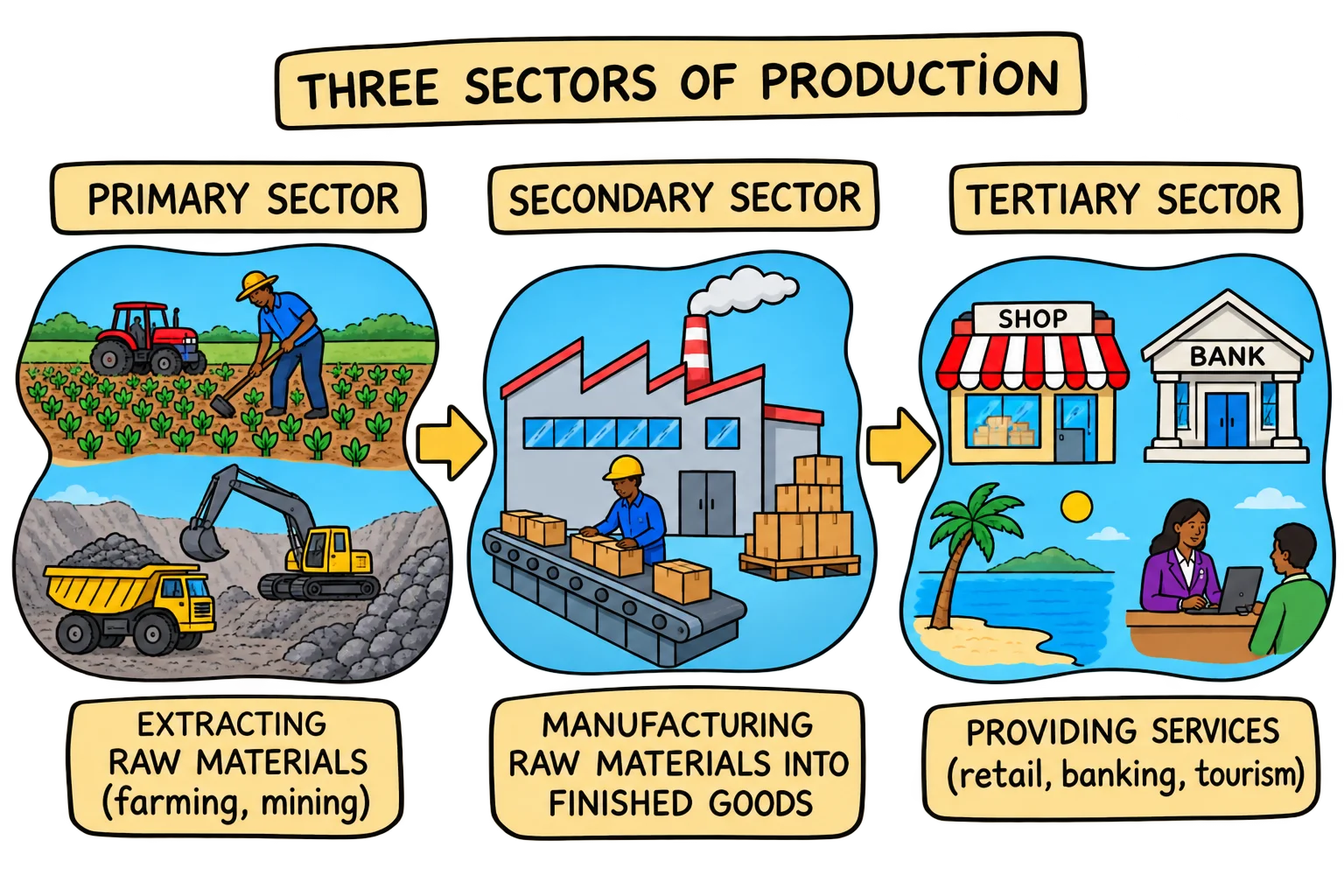
Production itself is often described in three stages. The primary sector extracts raw materials directly from nature (farming, mining, fishing). The secondary sector manufactures those raw materials into finished or semi-finished goods (construction, textiles, food processing). The tertiary sector provides services rather than physical goods (retail, banking, tourism, transport). As an economy develops, employment typically shifts from primary towards secondary and then tertiary activity — a pattern visible in Botswana's own shift away from reliance on cattle and mining towards services such as tourism and finance.
Business objectives, activity and stakeholders
A business activity is any activity that combines resources to produce goods or services, usually with the aim of satisfying customer wants at a profit. While profit maximisation is the most common objective, especially for private-sector firms, businesses may equally pursue survival (particularly when newly started or in a recession), growth in sales, market share or size, building a strong reputation for quality or ethics, or, for a charity or state enterprise, providing a service without necessarily seeking profit at all. Different objectives call for different strategies, and a business may shift its objective as it moves through different stages of its life.
A stakeholder is any individual or group with an interest in what a business does. Owners/shareholders want profit and a return on their investment; employees want fair pay, job security and good working conditions; customers want good quality, value for money and reliable service; suppliers want to be paid promptly and want repeat orders; the local community wants jobs and minimal environmental or social disruption; and government wants tax revenue and compliance with the law. These interests frequently conflict — for example, paying employees more (in their interest) reduces the profit available to shareholders (in their interest), and cutting costs to raise profit may mean laying off staff or cutting corners on environmental protection. A large part of exam-style analysis in this topic involves weighing up which stakeholder's interest a business decision favours, and at whose expense.
Business size, ownership and location
Business size is measured using several imperfect indicators — number of employees, value of annual output or sales, capital employed, and market share — and no single measure works for every business (a business with few, highly-paid employees might have huge output value, for instance), so examiners expect more than one measure to be considered together. Small businesses tend to offer flexibility and personal service and can react quickly to changes in customer taste, but usually cannot access the same finance, bargaining power or cost advantages as large firms. Large businesses can exploit economies of scale — falling average cost per unit as output rises, for example through bulk-buying discounts or spreading fixed costs over a larger volume — but tend to be less flexible and can suffer from poor internal communication as they grow (see Topic 5).
Location decisions weigh up the availability and cost of suitable land, access to labour with the right skills, proximity to raw materials and to the target market, the quality of transport and communication links, and government incentives such as grants or tax breaks for setting up in a targeted development area. A cement factory, tied to a heavy, low-value raw material, will typically locate near its quarry to minimise transport costs; a boutique clothing retailer will typically locate in a shopping mall with high customer footfall, since being close to customers matters more than being close to any raw material.
| Business structure | Ownership | Liability | Key advantage | Key disadvantage |
|---|---|---|---|---|
| Sole proprietorship | One person | Unlimited | Cheap and simple to set up; full control | Owner personally liable for all debts |
| Partnership | 2 or more people | Unlimited (unless limited partner) | Shared capital, skills and workload | Disputes between partners; shared unlimited liability |
| Private limited company | Shareholders (shares sold privately) | Limited | Owners' personal assets protected | More regulation; cannot sell shares to the public |
| Public limited company | Shareholders (shares sold on a stock exchange) | Limited | Can raise large amounts of capital | Heavy regulation; risk of takeover; ownership diluted |
| Cooperative | Members | Limited | Democratic, benefits shared among members | Slower decision-making; limited capital |
Beyond these core forms, a franchise lets an entrepreneur (the franchisee) pay for the right to trade under an established brand, using its products, systems and marketing, in exchange for an initial fee and ongoing royalties — a lower-risk route into business than starting an entirely new brand, though it limits the franchisee's independence. The state may also own and run businesses directly: nationalisation brings a business into full state ownership, privatisation sells a state-owned business to private owners, and commercialisation keeps a business under state ownership but requires it to operate on profit-seeking, commercial lines rather than being subsidised indefinitely.
Government and business
Government intervenes in business activity for several distinct reasons. It protects consumers from unsafe products, false advertising and unfair contract terms; it protects employees through minimum wage law, health and safety regulation, and protection against unfair dismissal or discrimination; it controls monopoly power so that a dominant firm cannot exploit consumers through excessive prices or restricted output; and it regulates the harm businesses can do to the environment through pollution controls and licensing.
Government also pursues its own macroeconomic objectives on behalf of the whole country: low and stable inflation (a general, sustained rise in prices), high employment, sustainable economic growth (a rise in the total value of goods and services produced), and a healthy balance of payments (the relationship between what a country earns from exports and spends on imports). To pursue these objectives it uses fiscal policy — adjusting government spending and taxation — and monetary policy — mainly adjusting interest rates and the money supply, usually through the central bank. A cut in interest rates, for example, makes borrowing cheaper, encouraging businesses to invest and consumers to spend, which can boost growth and employment but risks pushing up inflation if the economy is already near full capacity.
Topic 2
Marketing
There's more where that came from ✨
Subscribe and get everything, for every topic:
Topic 3
Finance
There's more where that came from ✨
Subscribe and get everything, for every topic:
Topic 4
Human Resources
There's more where that came from ✨
Subscribe and get everything, for every topic:
Topic 5
Production & Operations
There's more where that came from ✨
Subscribe and get everything, for every topic: