 Morutabana / study
Topic 1
Atomic Structure & the Periodic Table
Protons, neutrons and electrons
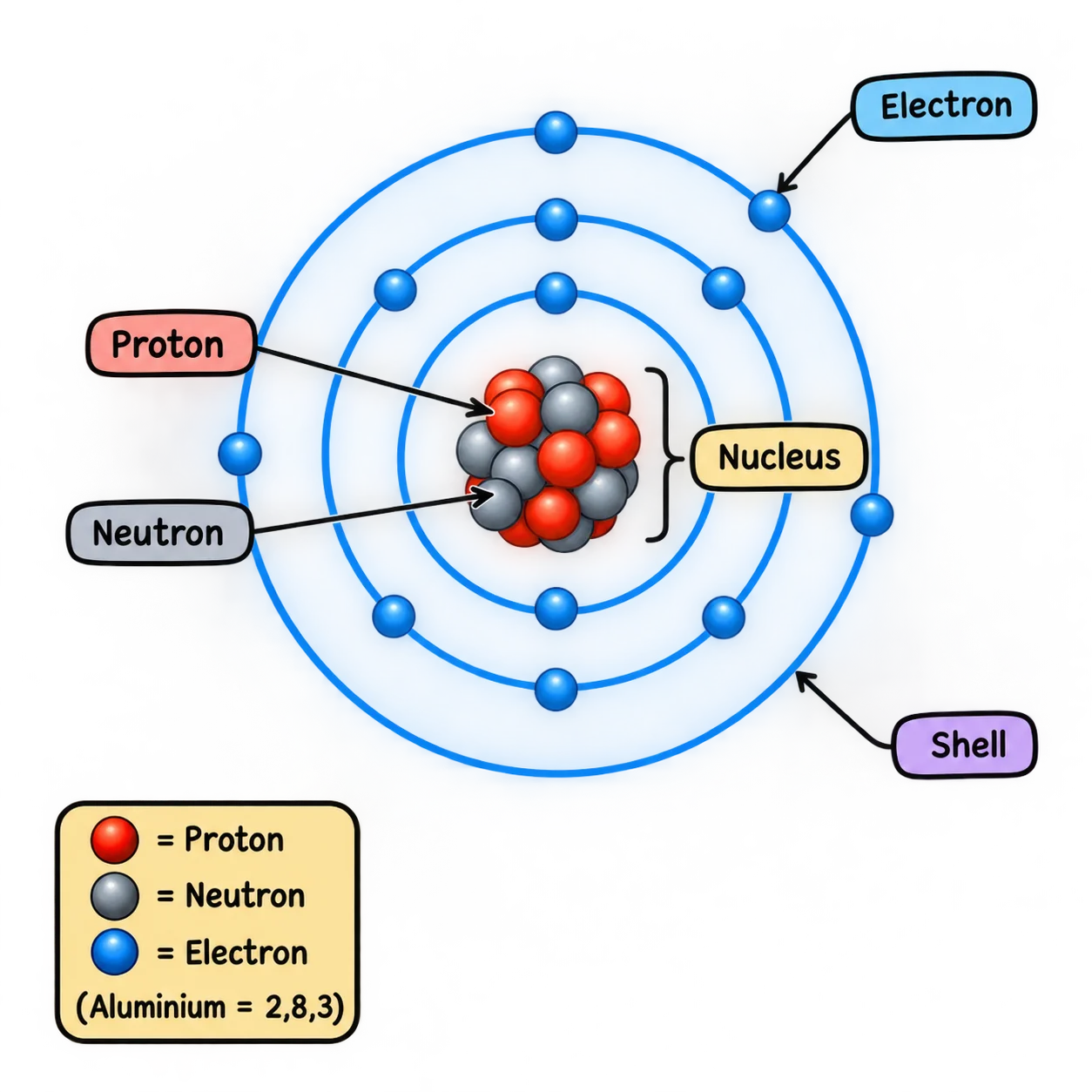
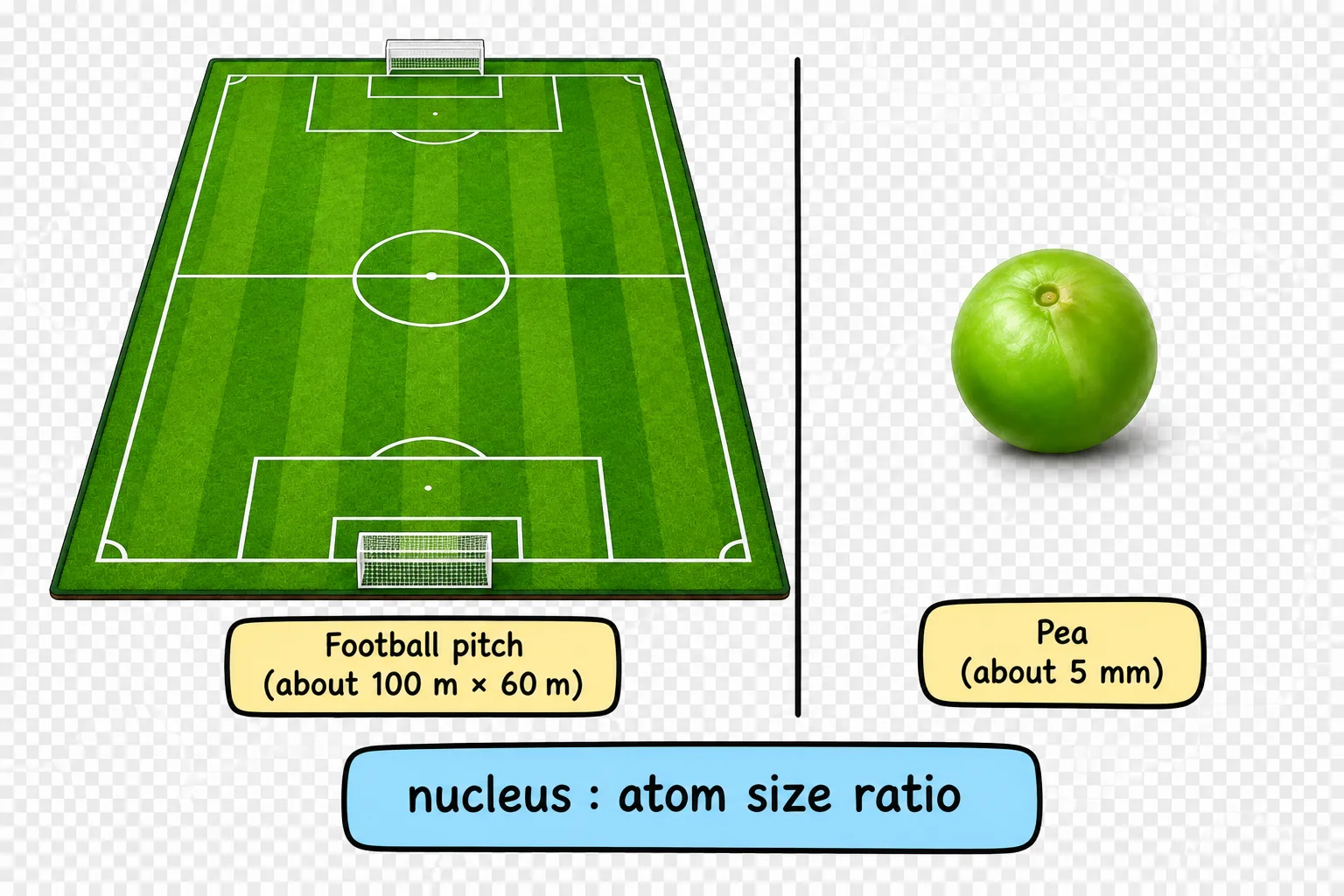
An atom is the smallest part of an element that can exist — a particle with no overall electric charge, made of a tiny central nucleus containing protons and neutrons, surrounded by electrons arranged in energy levels (shells). Atoms are almost unimaginably small, with a radius of about 0.1 nanometres (1 × 10⁻¹⁰ m), and the nucleus itself is roughly 1/10,000th the size of the whole atom — if the atom were the size of a football pitch, the nucleus would be about the size of a pea. Even so, because protons and neutrons are far heavier than electrons, almost all of an atom's mass sits in that tiny nucleus.
| Proton | Neutron | Electron | |
|---|---|---|---|
| Relative mass | 1 | 1 | very small |
| Relative charge | +1 | 0 | −1 |
| Location | nucleus | nucleus | energy levels (shells) |
Atoms are electrically neutral because the number of protons always equals the number of electrons, so the positive and negative charges cancel out exactly.
Atomic number, mass number and isotopes
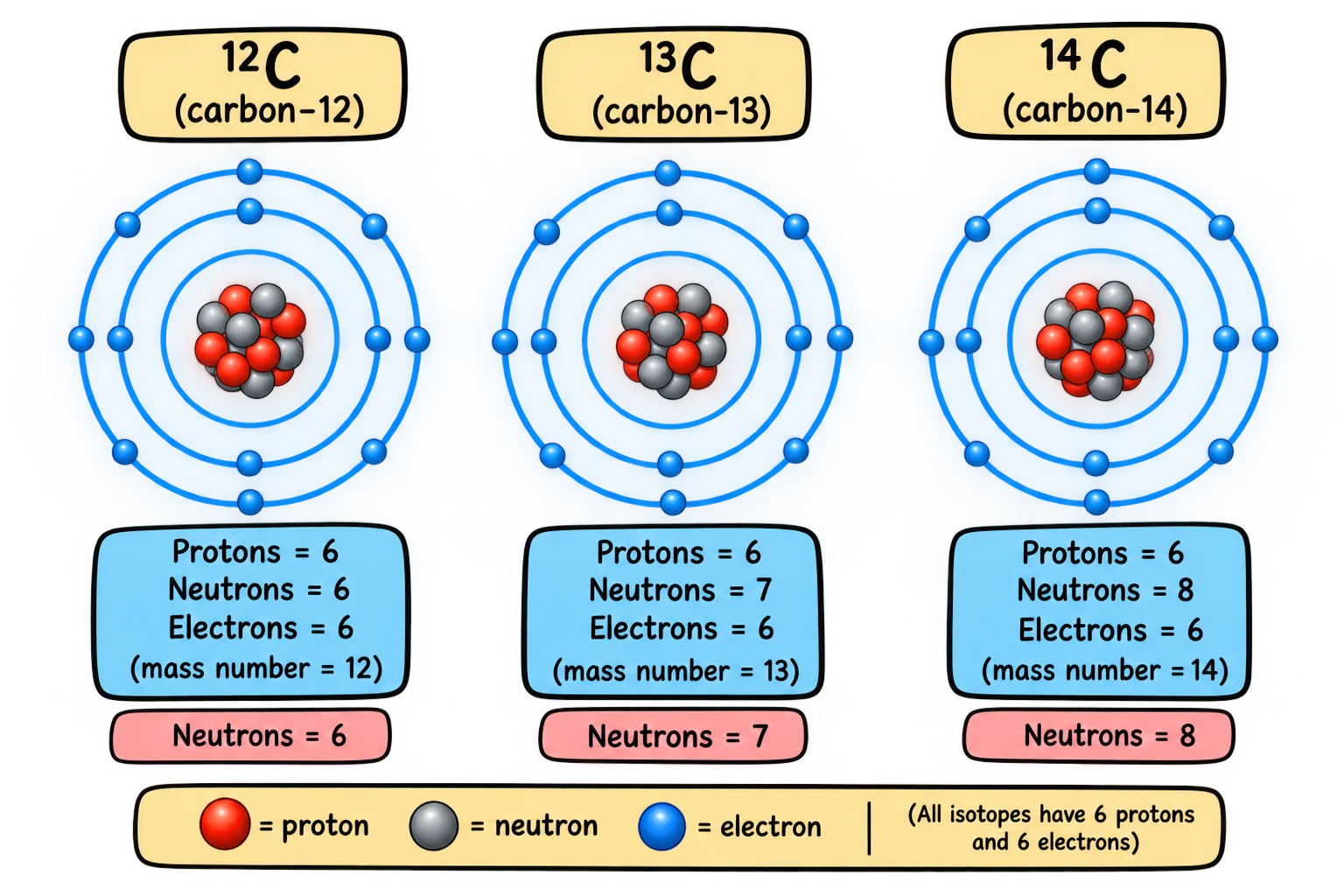
The atomic number (or proton number) is the number of protons in an atom, and it is this number that decides which element an atom is — every atom with 11 protons is sodium, no matter how many neutrons it has. The mass number is the total number of protons plus neutrons. From these two numbers you can work out everything about an atom's structure: the number of protons equals the atomic number, the number of neutrons equals the mass number minus the atomic number, and (for a neutral atom, not an ion) the number of electrons equals the atomic number too.
Atoms of the same element can have different numbers of neutrons — these are called isotopes. Isotopes have the same atomic number but different mass numbers, so they have identical chemical properties (since chemistry depends on electrons) but slightly different masses. Chlorine, for example, exists as 35Cl and 37Cl.
Protons = atomic number = 13
Neutrons = mass number − atomic number = 27 − 13 = 14
Electrons = atomic number (atom is neutral) = 13
Relative atomic mass
Because most elements are a mixture of isotopes in different proportions, chemists use relative atomic mass (Ar) — the average mass of the atoms of an element, weighted by how much of each isotope is present, on a scale where an atom of 12C is defined as exactly 12. This is why chlorine's Ar is 35.5 rather than a whole number.
Ar = (75 × 35 + 25 × 37) ÷ 100 = 3550 ÷ 100 = 35.5
Electron arrangement and ions
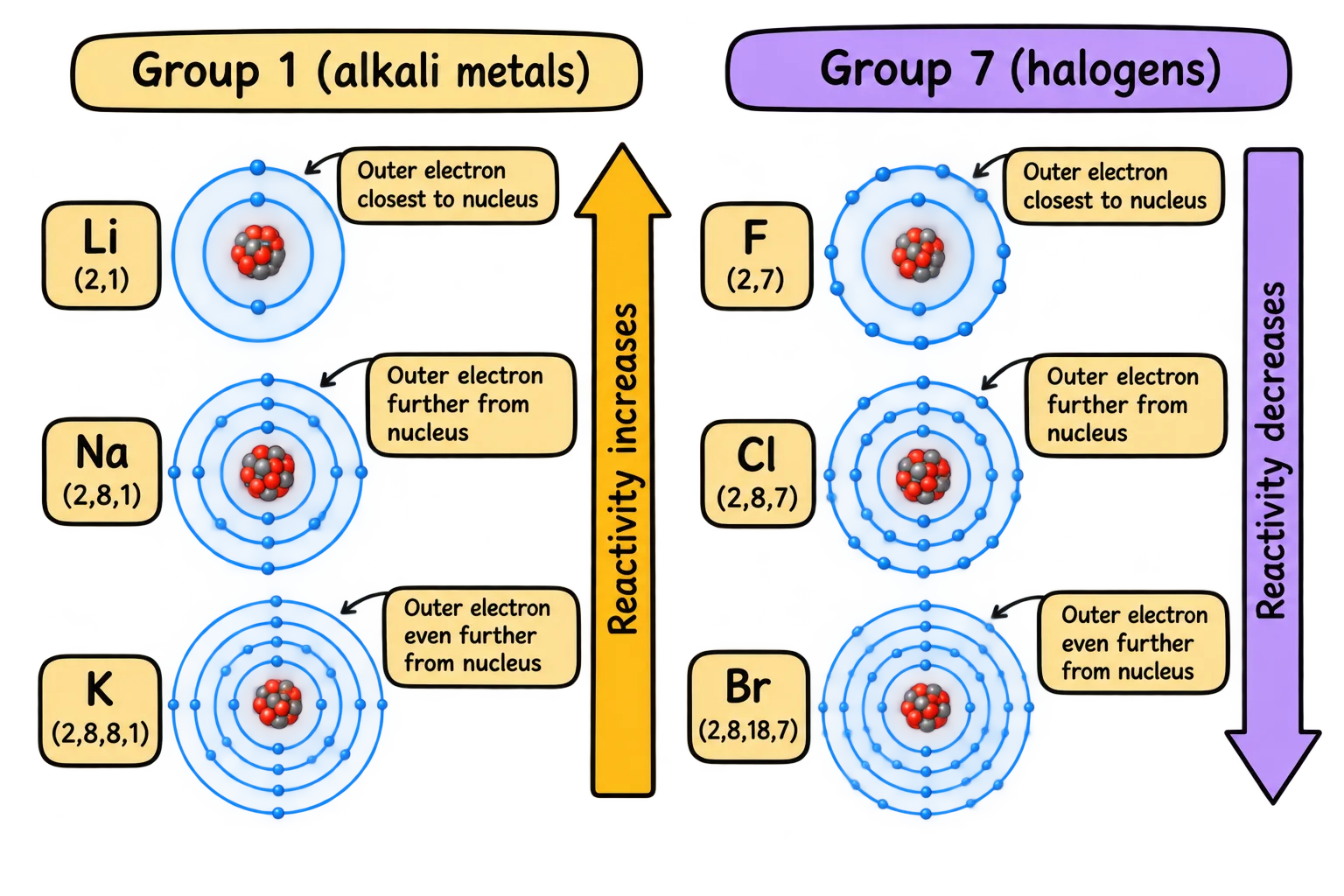
Electrons fill energy levels starting with the one closest to the nucleus: the first shell holds up to 2 electrons, the second and third shells hold up to 8 each. Aluminium (13 electrons) is written 2,8,3. Elements in the same group of the periodic table have the same number of electrons in their outer shell, which is why they react in similar ways.
An ion is a charged particle formed when an atom gains or loses electrons. Losing electrons leaves more protons than electrons, giving a positive ion (a metal atom losing electrons, e.g. Na → Na+); gaining electrons gives a negative ion (a non-metal atom gaining electrons, e.g. Cl + e− → Cl−). Atoms react by losing, gaining or sharing electrons so as to end up with the same stable electron arrangement as the nearest noble gas.
The periodic table
Elements are arranged in the periodic table in order of increasing atomic number. Vertical columns are called groups and share the same number of outer-shell electrons; horizontal rows are called periods. Metals sit on the left and in the middle (roughly three-quarters of all elements); non-metals sit on the right.
| Property | Metals | Non-metals |
|---|---|---|
| Conductivity | Conduct heat and electricity | Poor conductors (except graphite) |
| Appearance | Shiny, malleable | Dull, brittle as solids |
| Density / melting point | Usually high | Usually low |
| Ion formed | Positive ions | Negative ions |
| Oxides | Basic | Acidic |
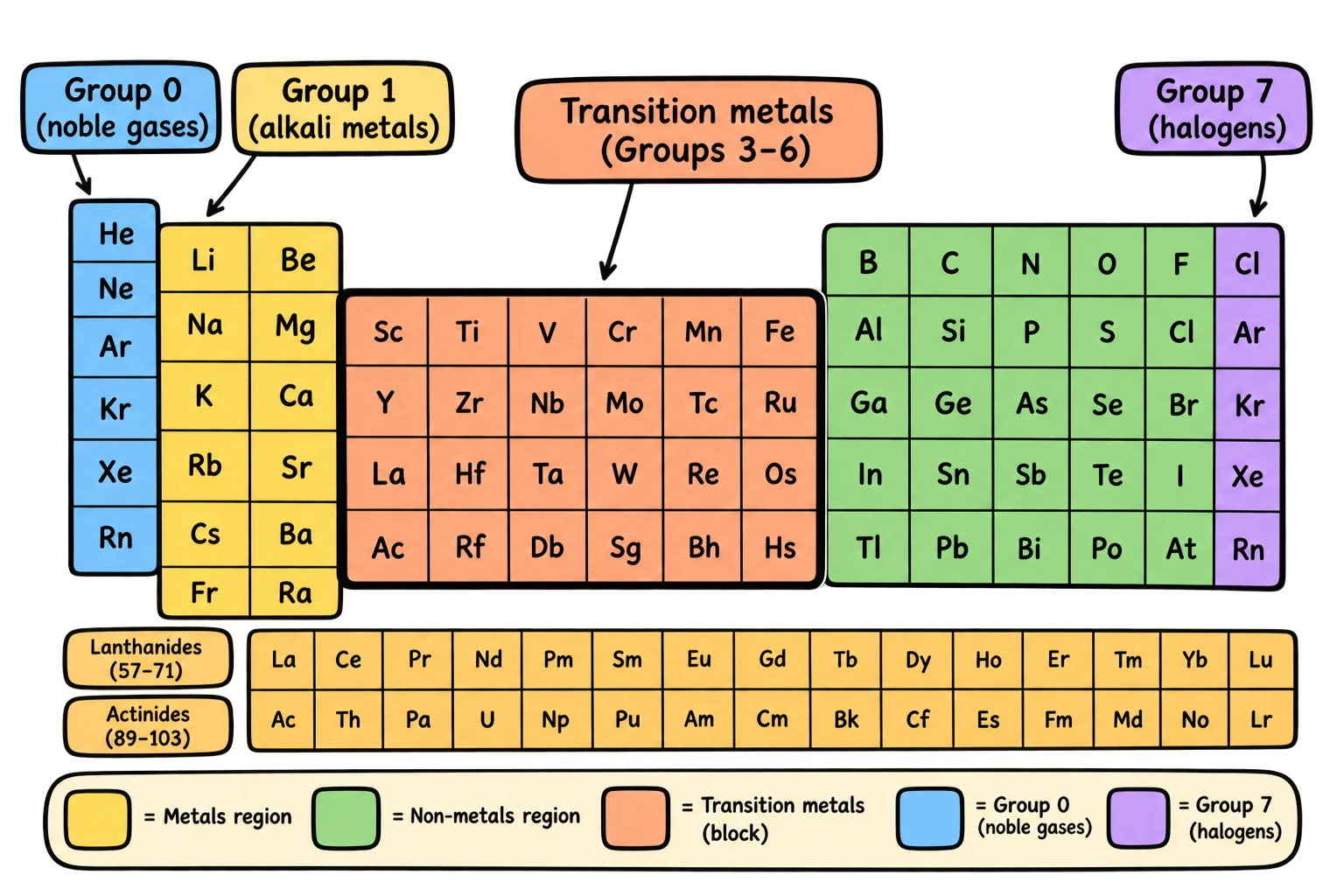
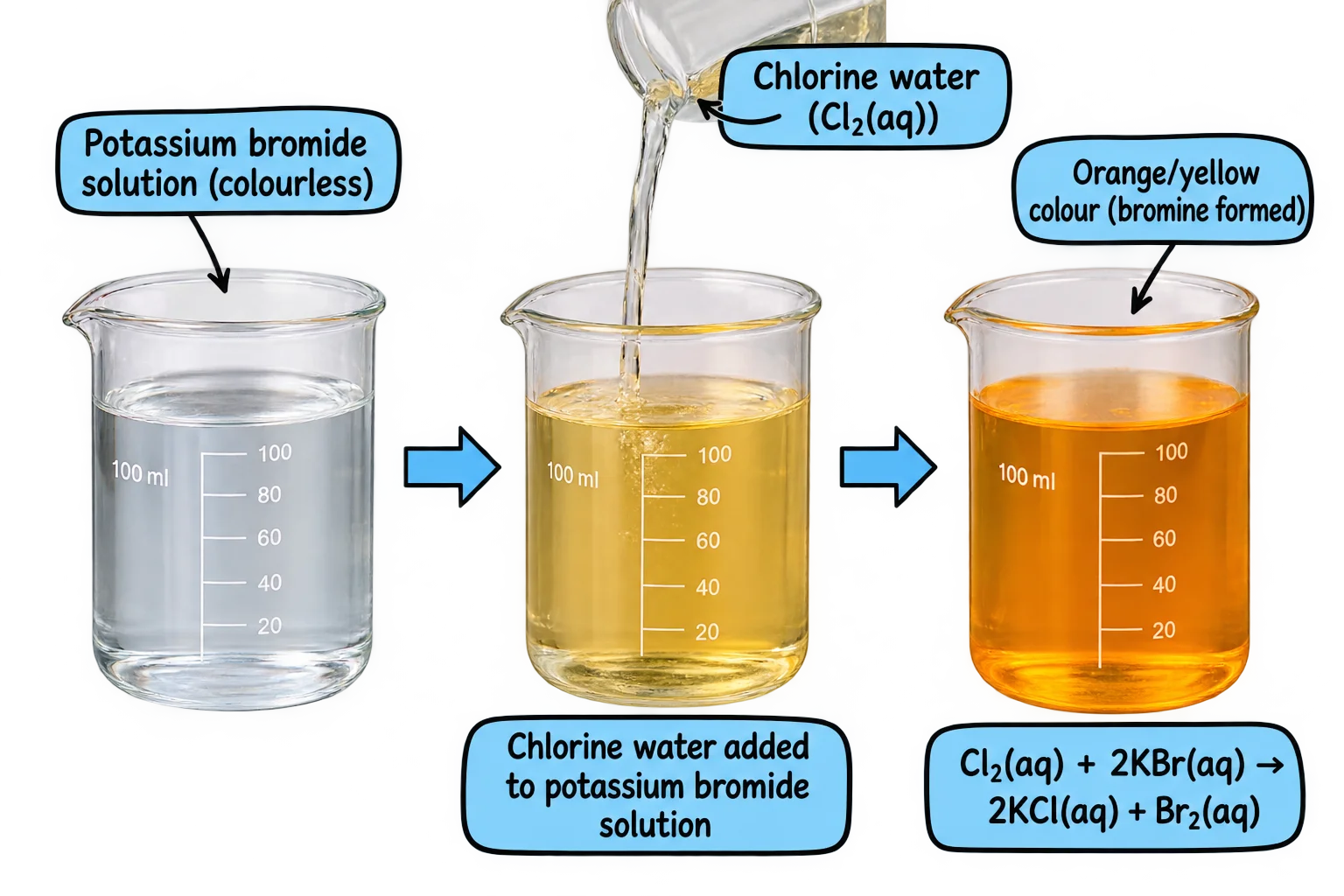
Group 0 (the noble gases — helium, neon, argon) have full outer shells, so they are extremely unreactive and exist as single atoms. Group 1 (the alkali metals — lithium, sodium, potassium) each have one outer electron, which they lose easily to form 1+ ions; reactivity increases going down the group because the outer electron is further from the nucleus and easier to remove. Group 7 (the halogens — fluorine, chlorine, bromine, iodine) each have seven outer electrons and exist as diatomic molecules (Cl2, Br2…); they gain one electron to form 1− ions, so reactivity here decreases going down the group, since the incoming electron has further to travel to reach the nucleus. A more reactive halogen can displace a less reactive one from a solution of its salt — chlorine will turn colourless potassium bromide solution orange as it displaces bromine.
The block of elements between Groups 2 and 3 are the transition metals (iron, copper, zinc…). Compared with the alkali metals they are much less reactive, much harder and denser, have much higher melting points, form ions of more than one charge (Fe2+ and Fe3+), form coloured compounds, and are often useful catalysts.
Mixtures and separation
A mixture contains two or more substances that are not chemically joined, so each substance keeps its own properties and can be separated by physical methods. This is different from a compound, where atoms of different elements are chemically bonded and can only be separated back into elements by a chemical reaction.
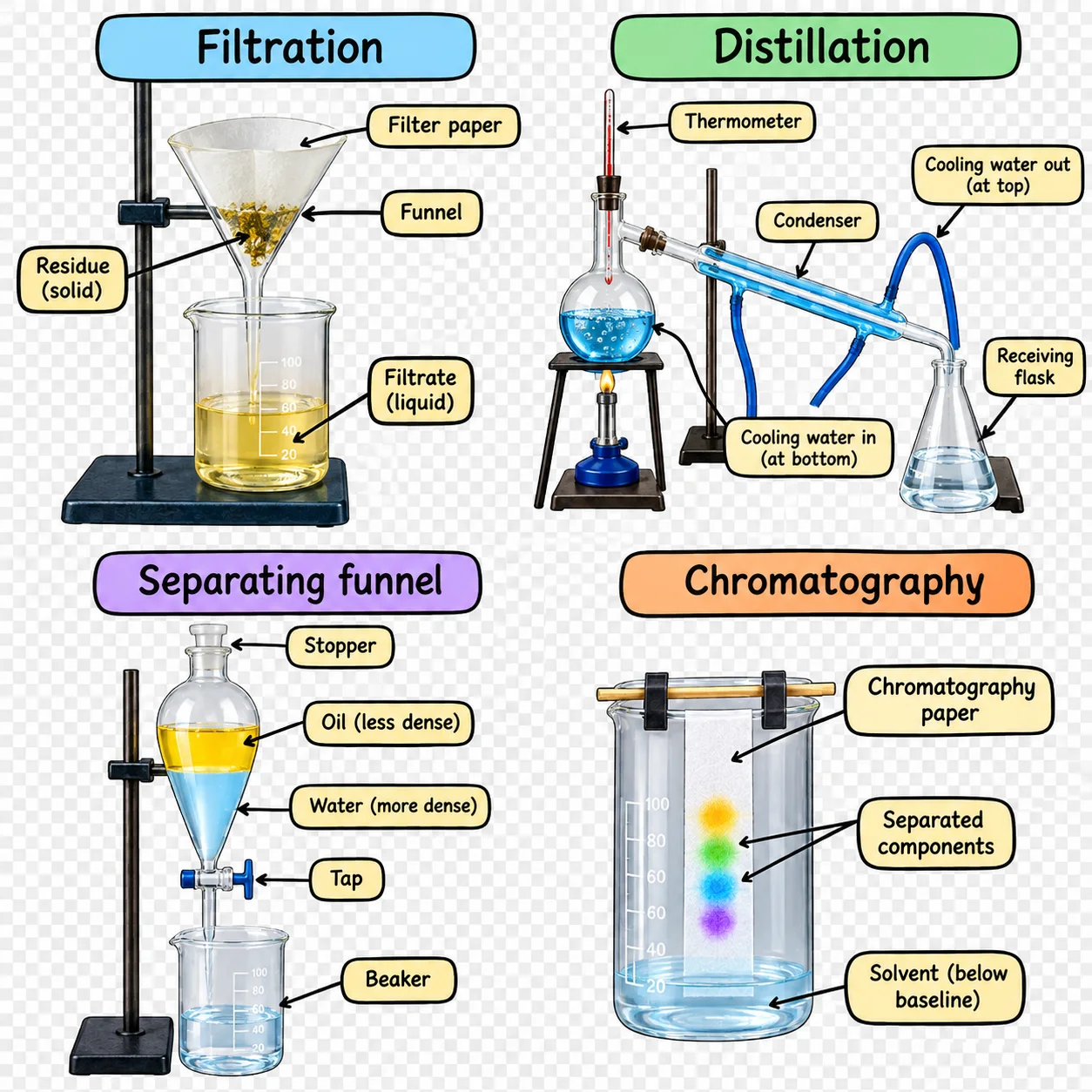
| Mixture type | Method |
|---|---|
| Insoluble solid + liquid | Filtration |
| Dissolved solid (keep solid) | Evaporation or crystallisation |
| Dissolved solid (keep solvent) | Simple distillation |
| Miscible liquids (different boiling points) | Fractional distillation |
| Immiscible liquids | Separating funnel |
| Dissolved coloured substances | Chromatography |
Topic 2
Bonding & Structure
There's more where that came from ✨
Subscribe and get everything, for every topic:
Topic 3
Chemical Calculations
There's more where that came from ✨
Subscribe and get everything, for every topic:
Topic 4
Chemical Changes
There's more where that came from ✨
Subscribe and get everything, for every topic:
Topic 5
Energy Changes & Rates
There's more where that came from ✨
Subscribe and get everything, for every topic:
Topic 6
Organic Chemistry
There's more where that came from ✨
Subscribe and get everything, for every topic:
Topic 7
Analysis & the Environment
There's more where that came from ✨
Subscribe and get everything, for every topic: