 Morutabana / study
Topic 1
Introduction to Agriculture
What is agriculture?
Agriculture is the science and practice of growing crops and raising or rearing livestock. It's done by everyone — boys and girls, men and women — not just one group of people. Agriculture also goes beyond just producing crops and animals: it includes the marketing, distribution, and transportation of agricultural products to the people who need them, wherever they live.
Example: A maize farmer in Pandamatenga doesn't just plant and harvest — the maize must then be transported to a depot, stored, milled, packaged, and distributed to shops across the country before it ever reaches a family's plate. Every one of these steps is part of agriculture, not just the growing itself.
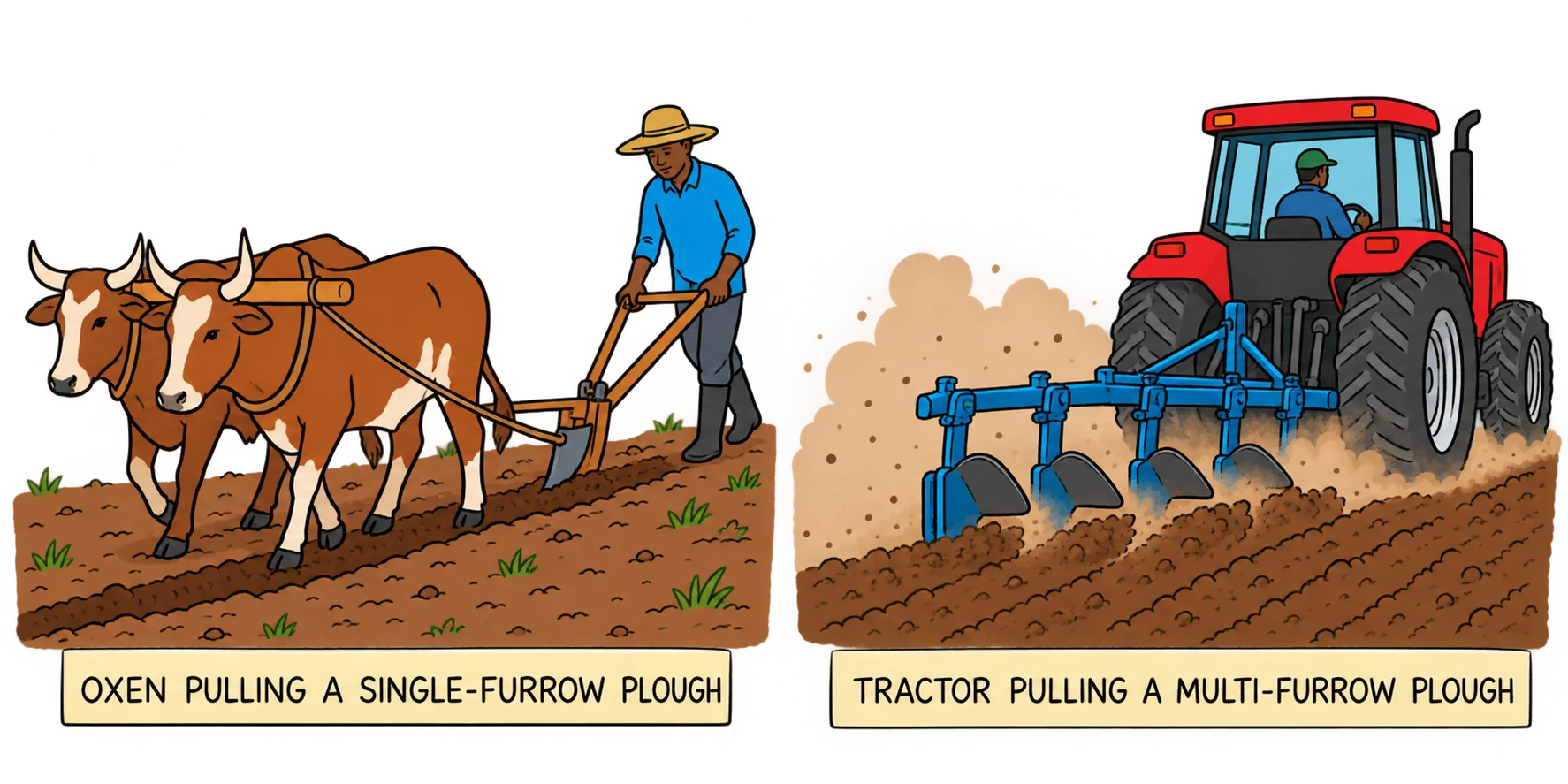
Agriculture in Botswana has changed a great deal over time. Traditional agriculture relied almost entirely on hand tools (hoes, digging sticks), animal draught power, indigenous seed varieties, and knowledge passed down between generations, with very little outside input. Modern agriculture makes use of tractors and other machinery, improved and hybrid seed varieties, chemical fertilisers and pesticides, irrigation systems, and scientific knowledge from research stations and extension officers. Most Batswana farmers today use a mixture of both — for example, ploughing with a tractor but still relying on family labour for weeding and harvesting.
Social and economic importance of agriculture
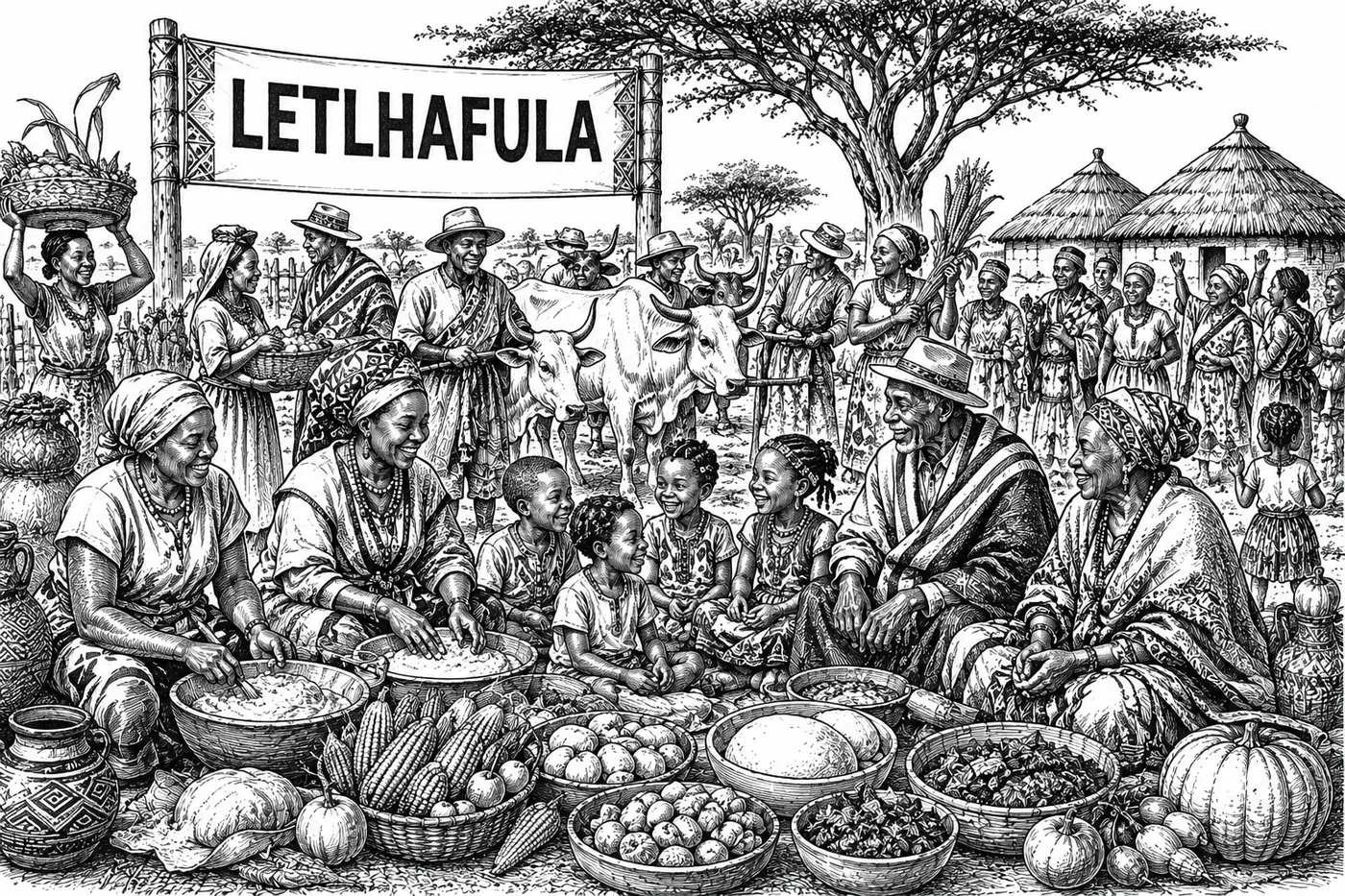
Agriculture has both social and economic value. Its social importance comes from how agricultural products are used in community life — cattle are used to pay bride price (lobola/bogadi), and food from agriculture is prepared for weddings, funerals, and cultural events like Letlhafula (harvest celebrations). Without agricultural produce, these social occasions wouldn't be possible.
Its economic importance covers all the ways agriculture helps people make and manage money:
- Source of income — people sell crops and livestock directly for money.
- Source of food — meat, eggs, milk, vegetables, and fruit all come from agriculture.
- Source of draught power — animals like donkeys, oxen, and horses pull ploughs, carts, and sledges.
- Source of raw materials for industry — meat for processing, cotton and wool for textiles, hides and skins for leather.
- Source of employment — farm workers, agricultural researchers, extension officers, veterinarians, and teachers of agriculture.
- Source of foreign exchange — Botswana earns foreign currency by exporting beef to countries like those in the European Union, and that money helps fund roads, schools, and hospitals.
Example: When the Botswana Meat Commission (BMC) exports beef to the European Union, the foreign currency earned doesn't just benefit the individual rancher — a portion flows into government revenue, which can then be spent on public infrastructure like clinics and schools, illustrating how one farmer's cattle sale connects to the wider national economy.
Social vs economic importance: telling them apart
- Social importance = agriculture's role in culture, tradition, and community relationships (lobola, funerals, festivals)
- Economic importance = agriculture's role in generating money, jobs, and materials
- A single product can serve both purposes: cattle provide economic income through sale AND social value through bogadi — note which purpose a question is actually asking about
The impact of HIV/AIDS on agriculture
Agriculture depends on people who are strong and healthy enough to plough fields and look after livestock. HIV/AIDS affects agricultural productivity in several ways: children whose parents have died from HIV/AIDS often lack the survival skills normally passed down through agricultural knowledge; some children become school dropouts to care for sick relatives, missing out on agriculture lessons taught at school; and since roughly 80% of Botswana's population farms, often in physically demanding rural work, illness among farmers directly reduces how much food gets produced.
Example: A household that loses its main breadwinner to HIV/AIDS-related illness may be forced to sell off cattle to cover medical and funeral costs, permanently reducing the family's future farming capacity even after the immediate crisis has passed.
Environmental impact of agricultural activities
Several common farming activities can damage the environment if not managed carefully:
- Ploughing — tractor fumes release poisonous carbon monoxide; loosened soil is easily blown away by wind; and tractors compact soil as they work, reducing water and air penetration.
- Clearing trees — cutting trees for firewood or fencing leads to deforestation, removing the root systems that hold soil in place and destroying habitat for creatures like birds and snakes.
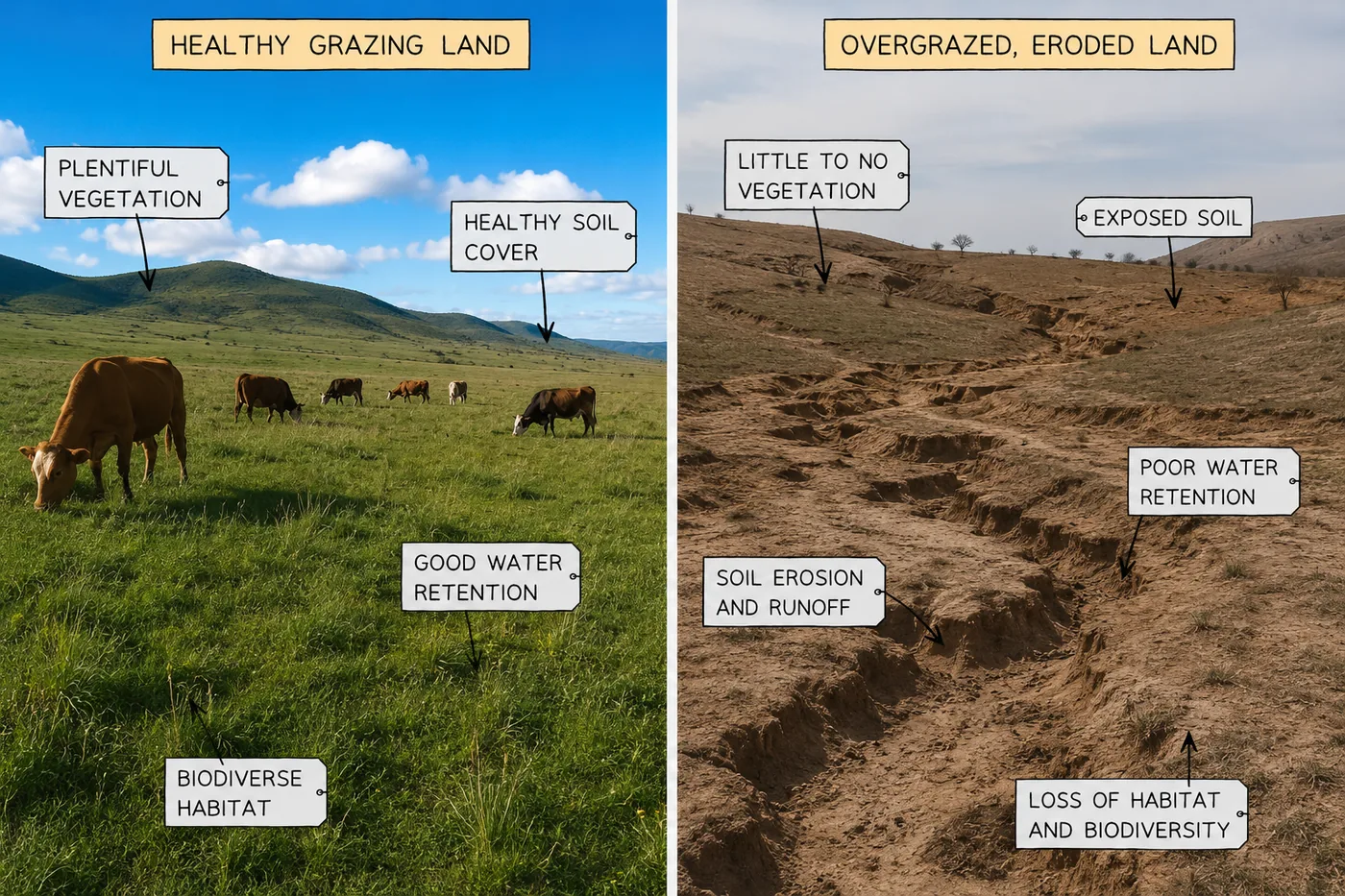
- Overstocking — keeping too many animals on a grazing area (more than the land can support) leads to overgrazing, leaving soil bare and exposed to erosion.
- Cultivating wet soil — digging soil that's still wet destroys its structure, since the air is pushed out and the soil becomes difficult to work once it dries.
Example: A cattle post with 200 cattle on land that can only sustainably support 100 will show visible bare patches, gully erosion, and declining grass cover within a few seasons — a direct, observable consequence of overstocking.
Branches of agriculture
Agriculture is often described as a tree with many branches, each dealing with a different aspect of farming:
| Branch | What it deals with |
|---|---|
| Animal Husbandry | Caring for animals for milk, meat, wool, eggs, and skins (includes poultry, beef, dairy, small stock, and pig production) |
| Agronomy | Caring for field crops like maize, sorghum, and sunflower, plus pasture management |
| Horticulture | Caring for fruit, vegetable, and flower crops (pomology, olericulture, floriculture) |
| Soil Science | Understanding soil and how it supports crops long-term (soil chemistry, survey, and physics) |
| Forestry | Caring for forests and marketing forest products like timber and firewood |
| Agricultural Engineering | Farm buildings, water systems, and machinery (water engineering, machinery engineering) |
| Agricultural Economics | Running agriculture as a business — production economics, marketing, and credit |
Example: A farmer deciding to plant a new fruit orchard would draw on horticulture for crop choice and care, soil science to check whether the land suits fruit trees, agricultural engineering to design an irrigation system, and agricultural economics to work out whether the orchard will be profitable — showing how the branches work together in practice, not in isolation.
Careers and training in agriculture
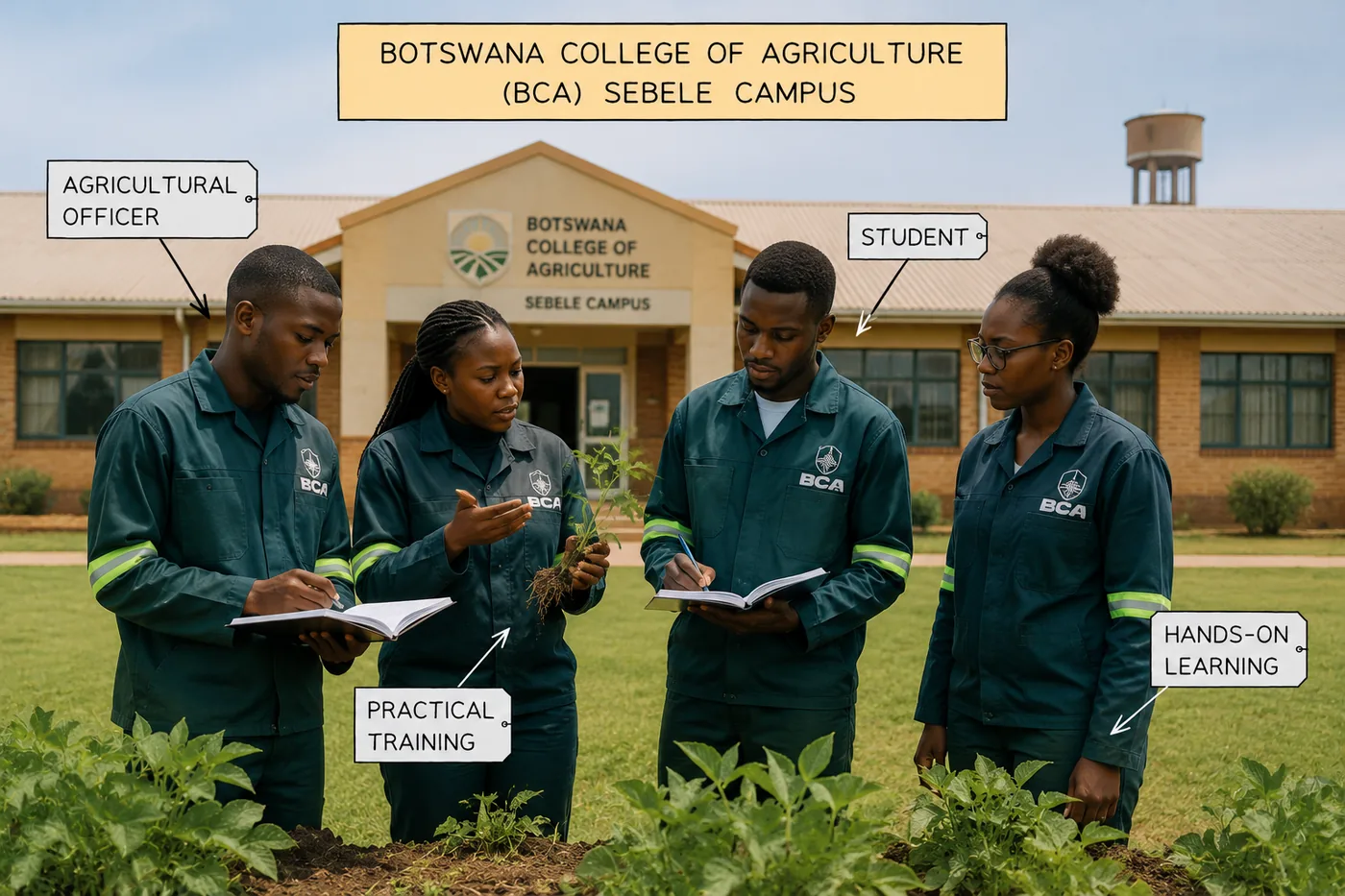
Every branch of agriculture needs trained people. Common careers include agricultural teachers, veterinary assistants, agricultural demonstrators (who teach farmers new methods and help them access government schemes like ALDEP), agricultural/extension officers, agronomists, animal husbandry officers, agricultural economists, soil scientists, foresters, agricultural engineers, ranch managers, and artificial inseminators.
To train for these careers in Botswana, you typically need at least JCE or BGCSE with credits in Agriculture and related science subjects. Training institutions include the Botswana College of Agriculture (BCA) at Sebele (certificate through degree level), Tonota College of Education (agriculture teacher training), other teachers' colleges (Lobatse, Tlokweng, Serowe, Francistown), Brigades and Vocational/Rural Training Centres, and the Ranch Management Training Centre (RMTC) in Ramatlhabama.
| Career | What they do | Typical training route |
|---|---|---|
| Agricultural demonstrator / extension officer | Visit farmers in the field to teach improved methods and link them to government schemes (e.g. ISPAAD) | Certificate/diploma from BCA |
| Veterinary assistant | Support animal health work — vaccinations, dipping, dosing, basic treatment | Certificate/diploma in animal health |
| Agriculture teacher | Teach agriculture in primary, junior, and senior secondary schools | Tonota College of Education, or a university education degree |
| Ranch manager | Oversee day-to-day running of a commercial cattle ranch — grazing, breeding, staff, finances | Ranch Management Training Centre (RMTC), Ramatlhabama |
| Agricultural engineer | Design farm structures, irrigation systems, and machinery solutions | Degree in agricultural engineering |
Example: A student who completes JCE Agriculture with a good grade could progress to a certificate at BCA, then work as an agricultural demonstrator, gaining field experience before studying further for a diploma or degree — showing agriculture careers often build step by step rather than requiring one long qualification from the start.
Food production, security, and self-sufficiency
These three terms are often confused but mean different things. Food production is raising crops and rearing livestock to increase local food output. Food security is a government policy ensuring food is always available on the market — from local production or imports — so the population never faces hunger. Food self-sufficiency means the population can produce enough food locally without needing to import.
In Botswana, local food production has generally not met demand (except for meat), so food security relies partly on imports, mainly from South Africa, plus neighbouring countries like Zambia and Zimbabwe.
Example: Botswana is largely food secure for maize (it's always available in shops) but NOT food self-sufficient in maize (much of it is imported from South Africa rather than grown locally). In contrast, Botswana is closer to self-sufficient in beef, since local cattle production comfortably meets domestic demand and even supports exports.
Food production vs security vs self-sufficiency
- Food production = the act of growing/rearing food (the activity itself)
- Food security = food is always available on the market, whether local or imported (the outcome/goal)
- Food self-sufficiency = ALL food demand met by local production alone, with no imports needed
- A country can be food secure WITHOUT being food self-sufficient (Botswana's maize situation is the classic exam example)
Factors limiting food production in Botswana
Unreliable rainfall, pests and diseases, lack of farming skills, poor soils, lack of capital, poor tools, poor market organisation, low household incomes, and poor storage facilities (causing perishable produce to spoil before it can be sold at a fair price) all limit how much food Botswana produces locally.
Example: A smallholder farmer may grow a good harvest of tomatoes, but without proper cold storage, much of the crop can rot within days if it isn't sold quickly — meaning poor storage, not poor growing skill, becomes the real bottleneck limiting how much reaches the market.
Government strategies to improve food production and security
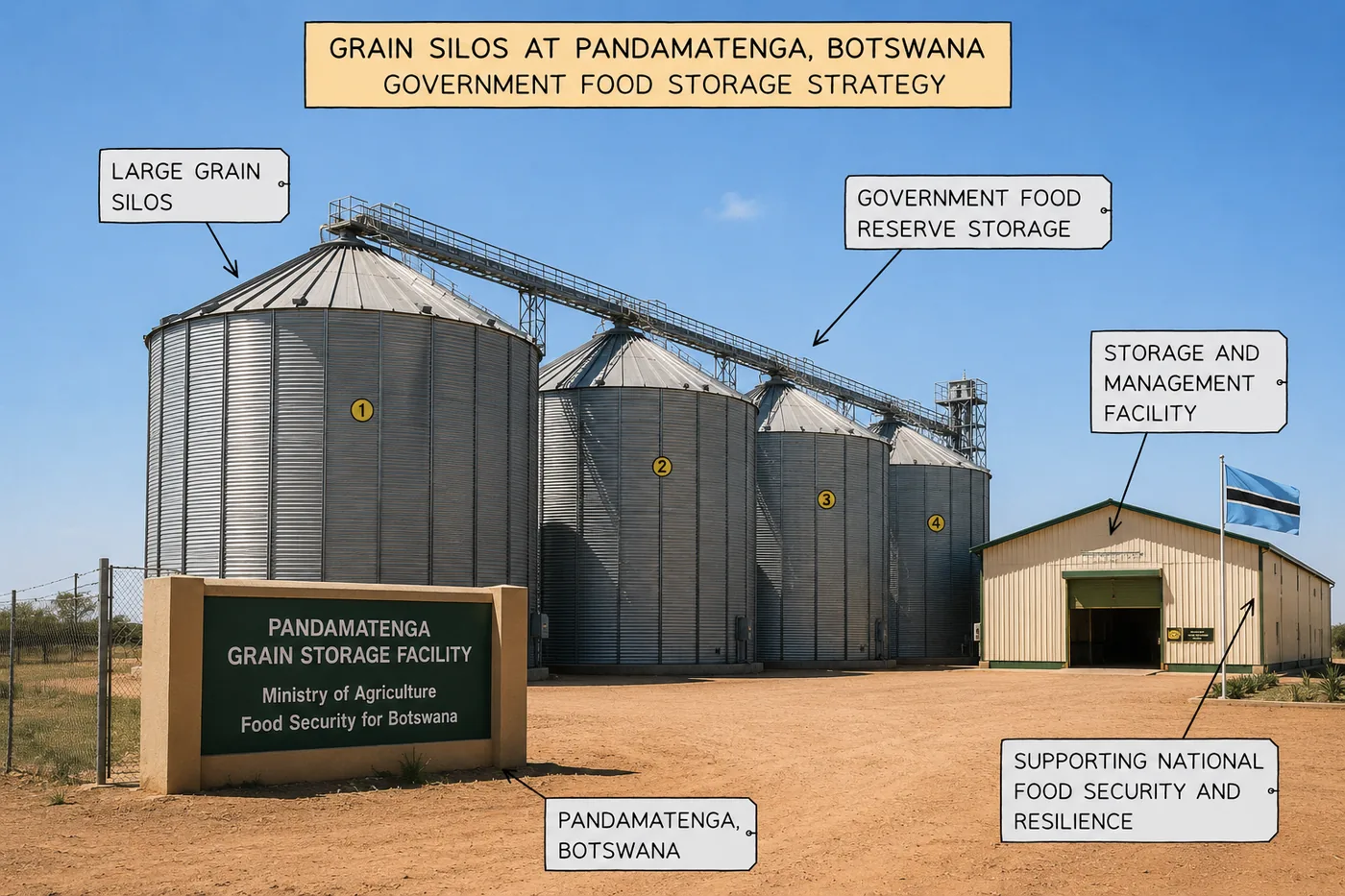
Botswana has used several strategies over the years: sponsored schemes like ALDEP, ARAP, and SLOCA (providing irrigation, free vaccinations, and training); financial assistance through the Young Farmers Fund; accessible loans through the National Development Bank and CEDA; drought relief through Ipelegeng; free seeds, fertiliser, and tractor access through ISPAAD; research support including subsidised artificial insemination and the Seed Multiplication Unit at Sebele; unrestricted importation of foodstuffs; and proper storage infrastructure, including silos at Pitsane and Pandamatenga.
Types of farming
Botswana has three basic farming systems: arable farming (growing crops only), pastoral farming (keeping livestock only, also called livestock farming), and mixed farming (both crops and livestock on the same farm — the most common approach among Batswana farmers).
Levels of farming
Farming also happens at different levels of scale and intent. Subsistence farming produces just enough to feed the farmer's own family, using mostly hand labour and simple tools, without a primary goal of making a profit. Commercial farming is run as a business — larger scale, more capital invested (machinery, boreholes, fertiliser, hired skilled labour), with profit as the goal.
These combine into recognisable categories: subsistence arable farming (small-scale crop growing for home use, still the norm in most rural Botswana communities); commercial arable farming (large-scale, e.g. at Pandamatenga and Tuli Block); subsistence livestock farming (a family's cattle at the cattle post/moraka, managed more for household needs than profit); commercial livestock farming (large beef or dairy operations, with Botswana's commercial ranching sector being especially significant for BMC beef exports); and both subsistence and commercial versions of mixed farming.
Subsistence vs commercial: the key differences
- Goal: subsistence = feed the family; commercial = make a profit
- Scale: subsistence = small; commercial = large
- Capital/technology: subsistence = mostly hand labour, simple tools; commercial = machinery, boreholes, fertiliser
- Labour: subsistence = family members; commercial = hired, often skilled workers
- Type (arable/pastoral/mixed) and level (subsistence/commercial) are independent classifications — a farm can be any combination, e.g. commercial AND mixed
Problems commercial farmers face
Commercial farmers in Botswana commonly struggle with expensive land, limited markets for some products, difficulty finding skilled labour, high utility costs (water, electricity, communication), HIV/AIDS-related worker illness reducing productivity, and poor infrastructure (roads) leading to their farms.
Example: A commercial vegetable farmer near Gaborone may produce an excellent crop of cabbages, but if the access road to the farm floods every rainy season, trucks cannot reach the farm to collect produce on time, causing losses despite the farming itself being successful.
Modern trends shaping Botswana agriculture
Agriculture keeps changing in response to climate and technology. Key trends examiners expect you to know:
- Climate-smart agriculture — methods that cope with Botswana's unreliable, decreasing rainfall, such as drought-tolerant seed varieties, conservation tillage (minimum ploughing to protect soil moisture), and rainwater harvesting.
- Mechanisation — more farmers accessing tractors and implements through government tractor-hire schemes, reducing reliance on animal draught power and speeding up land preparation.
- Irrigation expansion — boreholes, dams, and drip irrigation allow crop production to continue even when rainfall fails, especially for horticulture near urban centres.
- Value addition — farmers and companies processing raw produce (e.g. milling sorghum into malutu, or making yoghurt from milk) to earn more money than selling the raw product alone.
- ICT in agriculture — mobile phones used to check market prices, weather forecasts, and receive extension advice remotely, especially useful for farmers in remote cattle posts.
Example: A dairy farmer who used to sell only raw milk can add value by processing it into yoghurt or sour milk (madila) before selling, earning a higher price per litre than selling milk unprocessed — the same raw material, but more income through value addition.
Exam tip: linking topics back to Topic 1
- Many exam questions ask you to justify WHY something is done, not just describe it — tie your answer back to economic importance (income, food, employment) or environmental impact where relevant
- If a question gives you a scenario (a specific farmer, a specific place in Botswana), first identify which type and level of farming it is before answering the rest of the question
- Don't confuse "food security" with "food self-sufficiency" — this mix-up is one of the most common mistakes in this topic
Topic 2
Crop Production
There's more where that came from ✨
Subscribe and get everything, for every topic:
Topic 3
Livestock Production
There's more where that came from ✨
Subscribe and get everything, for every topic:
Topic 4
Soil Science
There's more where that came from ✨
Subscribe and get everything, for every topic:
Topic 5
Farm Tools
There's more where that came from ✨
Subscribe and get everything, for every topic:
Topic 6
Farm Records
There's more where that came from ✨
Subscribe and get everything, for every topic:
Topic 7
Vegetable Production
There's more where that came from ✨
Subscribe and get everything, for every topic:
Topic 8
Fruit Production
There's more where that came from ✨
Subscribe and get everything, for every topic:
Topic 9
Forestry
There's more where that came from ✨
Subscribe and get everything, for every topic:
Topic 10
Agribusiness Management
There's more where that came from ✨
Subscribe and get everything, for every topic:
Topic 11
Poultry Production
There's more where that came from ✨
Subscribe and get everything, for every topic:
Topic 12
Beef Cattle Production
There's more where that came from ✨
Subscribe and get everything, for every topic:
Topic 13
Dairy Production
There's more where that came from ✨
Subscribe and get everything, for every topic:
Topic 14
Goat & Sheep Production
There's more where that came from ✨
Subscribe and get everything, for every topic:
Topic 15
Beekeeping
There's more where that came from ✨
Subscribe and get everything, for every topic:
Topic 16
Fish Farming
There's more where that came from ✨
Subscribe and get everything, for every topic:
Topic 17
Pig Production
There's more where that came from ✨
Subscribe and get everything, for every topic:
Topic 18
Rabbit Production
There's more where that came from ✨
Subscribe and get everything, for every topic: