
Home / JCE / Science

JCE Science

Life, matter, forces, and the human body for JCE. Work through each topic's notes, flashcards, and exam-style questions.

Topic 1

Science, Technology and Society

Lesson 1: The Nature of Science

Science is the systematic study of the natural world through observation, experimentation, and reasoning. It seeks to explain how and why things happen using evidence rather than guesswork or superstition.

The scientific method is a step-by-step process scientists use to investigate questions: making an observation, forming a hypothesis (a testable prediction), carrying out an experiment to test it, recording and analysing results, and drawing a conclusion. If the results don't support the hypothesis, it is revised and tested again.

Observation Hypothesis (testable prediction) Experiment (fair test) Record & analyse results Conclusion If not supported, revise & retest
The scientific method is a cycle, not a one-way line: if results don't support the hypothesis, scientists revise it and test again rather than starting over.

A fair test only changes one variable at a time (the independent variable) while keeping all others constant (controlled variables), so that any change observed in the result (the dependent variable) can be confidently linked to the one thing that was changed.

Example: A student wants to test whether the amount of sunlight affects how tall a bean plant grows. The independent variable is sunlight exposure (e.g. 2 hours vs 8 hours daily). The dependent variable is plant height, measured weekly. Controlled variables must include the same soil type, pot size, water amount, and bean variety for every plant — otherwise, any height difference couldn't be confidently blamed on sunlight alone.

Science is divided into branches, including Biology (the study of living things), Chemistry (the study of matter and its changes), and Physics (the study of matter, energy, and forces).

Designing a fair test: the checklist

  • Identify ONE independent variable to change deliberately
  • Identify the dependent variable — the one thing you measure as a result
  • List every other factor that could affect the outcome, and keep ALL of them constant (controlled variables)
  • If two things change at once, you can never be sure which one caused the result — this is the single most common mistake in exam experiment-design questions

Lesson 2: Laboratory safety

A science laboratory contains equipment, chemicals, and heat sources that can cause harm if used carelessly. A hazard is anything with the potential to cause harm; a risk is the chance that the hazard will actually cause harm. Good laboratory practice is about reducing risk — not just knowing hazards exist, but controlling how you work around them.

Laboratory hazards fall into several types:

Type of hazardExamplesMain danger
ChemicalAcids, alkalis, solventsBurns, poisoning, fumes
BiologicalBacteria, moulds, body fluidsInfection, disease
Physical/mechanicalBroken glassware, sharp instrumentsCuts, puncture wounds
ThermalBunsen burners, hot plates, boiling waterBurns, scalds, fire
ElectricalDamaged wires, wet equipment plugged inShocks, fire

Hazard symbols

Chemicals and equipment are labelled with standard hazard symbols (warning pictograms) so that a danger can be recognised at a glance, even before reading the label in full. Diamond-shaped symbols with a red outline warn of a chemical hazard (e.g. toxic, corrosive, oxidising, explosive); yellow triangles warn of a physical danger (e.g. electric shock, flammable, laser); circular symbols show a mandatory action (e.g. wear gloves) or a prohibition (e.g. no naked flames); and green or red rectangles show the location of safety equipment (e.g. eyewash station, first aid kit).
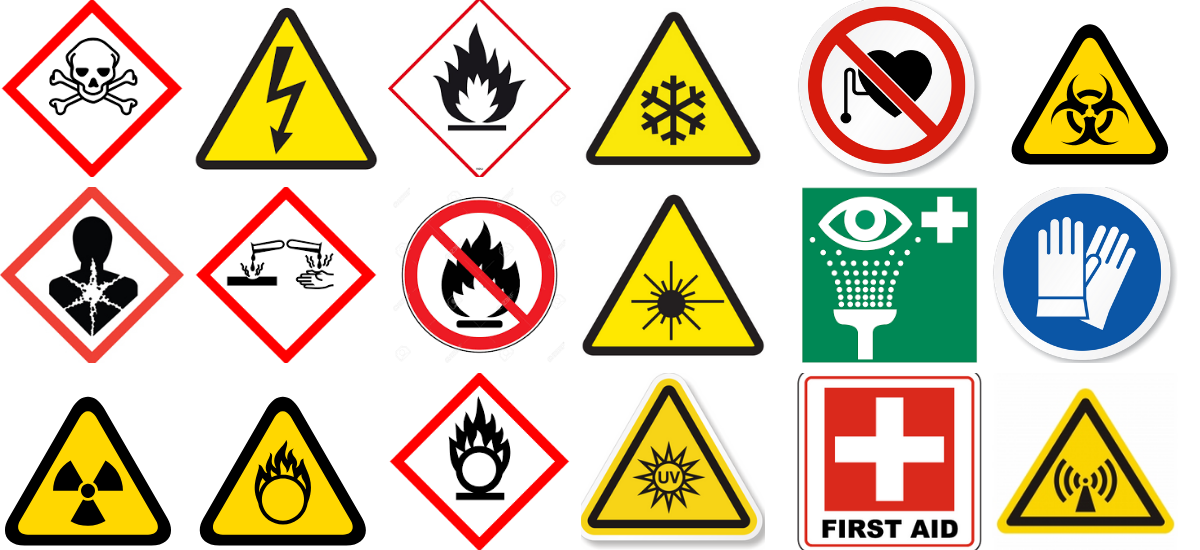
Grid of standard laboratory and workplace hazard symbols, including toxic (skull and crossbones), electric shock, flammable, freezing/low temperature, no medical implants, biohazard, health hazard, corrosive, no naked flame, laser, eyewash station, mandatory gloves, radioactive, oxidising, explosive, UV radiation, first aid, and non-ionising radiation
Common hazard and safety symbols found in a science laboratory. Recognising these on a chemical bottle, piece of equipment, or wall sign tells you the type of danger — or the safety equipment available — before you even read the label.

Key laboratory safety rules:

Laboratory dos and don'ts

  • Do wear safety goggles/eye protection whenever handling chemicals or heating substances
  • Do tie back long hair and avoid loose clothing or sleeves near an open flame
  • Do read chemical labels and check hazard symbols before use
  • Do report spills, breakages, and injuries to the teacher immediately
  • Do know the location of the fire extinguisher, fire blanket, eyewash station, and first aid kit before starting practical work
  • Do point test tubes being heated away from yourself and others
  • Don't taste, smell directly, or touch chemicals with bare hands
  • Don't eat, drink, or run in the laboratory
  • Don't point the open end of a heated test tube at anyone
  • Don't return unused chemicals to their original container (this risks contaminating the whole stock)
  • Don't work in the laboratory unsupervised or without permission
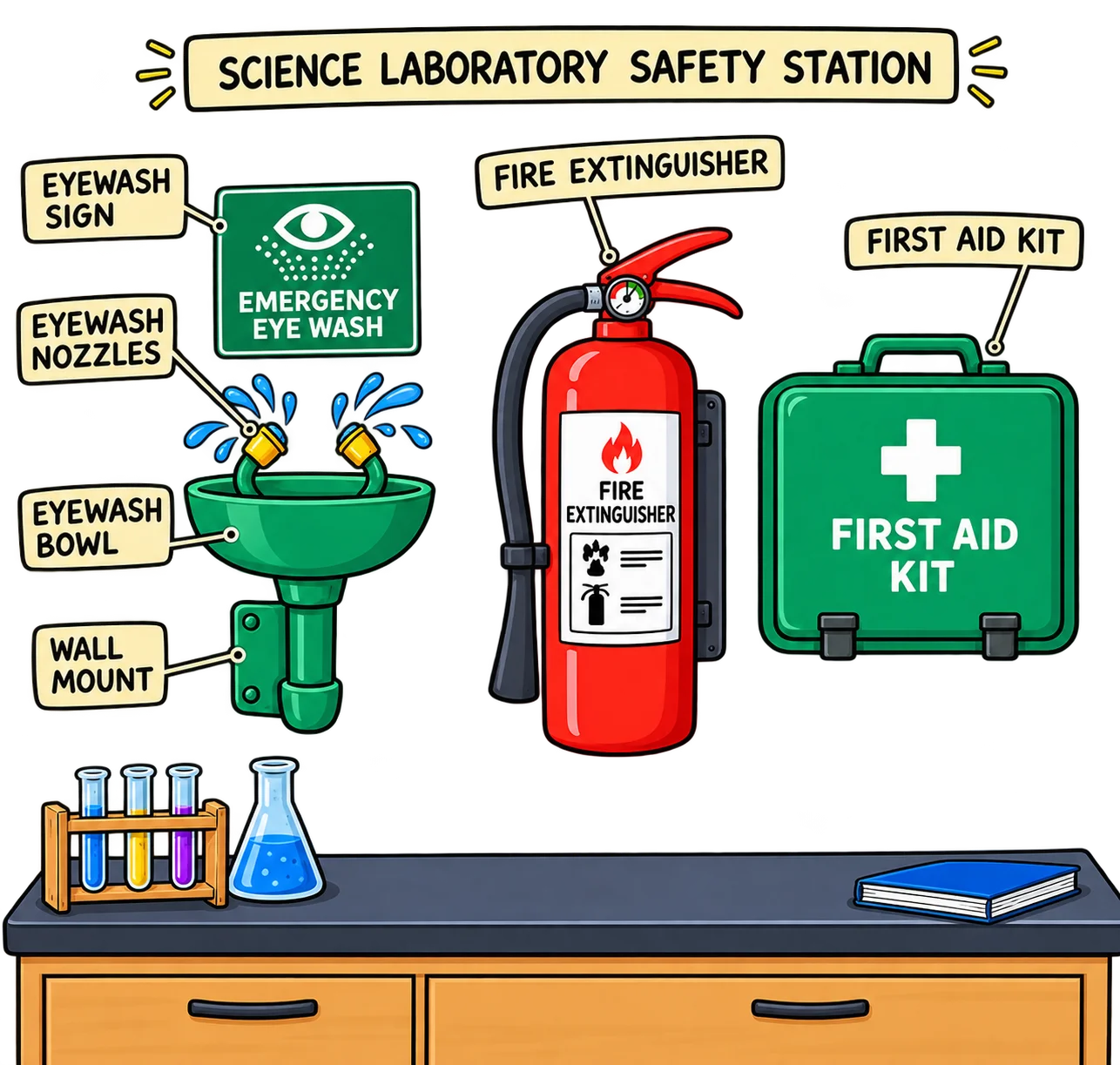
Photo of a school science laboratory safety station showing eyewash, fire extinguisher, and first aid kit locations

Lesson 3: Measurements

Measurement is the process of comparing a quantity to a standard unit. Scientists use the SI system (International System of Units) for consistency across the world.

QuantitySI UnitSymbolInstrument
LengthmetremRuler, metre rule, tape measure
MasskilogramkgBalance (beam or electronic)
TimesecondsStopwatch, clock
Temperaturedegree Celsius°CThermometer
Volumecubic metre / litrem³ / lMeasuring cylinder, burette

When reading a measuring cylinder containing a liquid, always read the meniscus (the curved surface of the liquid) at eye level, taking the reading from the bottom of the curve for most liquids.

Accuracy describes how close a measurement is to the true value. Precision describes how consistent repeated measurements are with each other, whether or not they are accurate.

Example: A student weighs the same 100g standard mass five times on a faulty balance and gets 92g, 93g, 92g, 93g, 92g. These results are precise (very consistent with each other) but not accurate (all far from the true value of 100g) — showing the balance itself needs recalibrating, since the student's technique is clearly consistent.

Accuracy vs precision: don't mix them up

  • Accurate = close to the TRUE value
  • Precise = repeated measurements are close to EACH OTHER (consistent), regardless of whether they're correct
  • A measurement can be precise but not accurate (consistently wrong), accurate but not precise (right on average, but scattered), both, or neither
  • Best practice in any experiment: take repeated measurements and calculate an average, which improves reliability

Scalars and vectors

Every quantity measured in science is either a scalar or a vector. A scalar quantity has magnitude (size) only — a number and a unit is all that's needed to describe it fully. A vector quantity has both magnitude and direction — giving the size alone is not enough to describe it fully.

Scalars (magnitude only)Vectors (magnitude + direction)
Length, distanceDisplacement
MassWeight
TimeForce
TemperatureVelocity
SpeedAcceleration
Volume, areaMomentum

Example: saying a car travels "60 km/h" describes its speed (a scalar). Saying it travels "60 km/h due north" describes its velocity (a vector) — the direction makes it a different kind of quantity. Vectors are often drawn as arrows, where the length of the arrow represents the magnitude and the way it points represents the direction.

20 N 40 N
A vector is drawn as an arrow: its length shows magnitude (bigger force = longer arrow) and the direction it points shows the vector's direction.

Measuring area

Area is the amount of surface a two-dimensional shape covers, measured in square units (e.g. cm², m²). For regular shapes, area is found using a formula:

ShapeFormula
Rectangle/squareArea = length × width
TriangleArea = ½ × base × height
CircleArea = π × radius²
Worked example A rectangular lab bench top measures 120 cm by 50 cm. Find its area.

Area = length × width = 120 × 50 = 6 000 cm²

For an irregular shape (one with no simple formula, e.g. a leaf), area is estimated by placing the shape on graph paper (a grid): count every full square the shape covers, then count part-squares as roughly a half each, and add the totals together.

Estimating the area of an irregular shape: place it over a grid, count full squares, count part-squares as approximately half a square each, then add the totals.

Measuring volume

Volume is the amount of space a three-dimensional object occupies, measured in cm³ or m³ (or litres for liquids). A regular solid's volume is found with a formula:

ShapeFormula
Cube/cuboidVolume = length × width × height
CylinderVolume = π × radius² × height
Worked example A wooden block is 5 cm long, 4 cm wide, and 3 cm high. Find its volume.

Volume = length × width × height = 5 × 4 × 3 = 60 cm³

The volume of an irregular solid (e.g. a stone) that sinks in water is found by the displacement method: partly fill a measuring cylinder with water and record the level; lower the object in on a thread until fully submerged; record the new, higher level; the difference between the two readings is the volume of the object.

50 mL Before 72 mL After
Displacement method: the water level rises from 50 mL to 72 mL when the stone is added, so the stone's volume is 72 − 50 = 22 cm³ (1 mL = 1 cm³).
Worked example — displacement A measuring cylinder reads 50 cm³ before a stone is lowered in, and 72 cm³ after. Find the volume of the stone.

Volume of stone = final reading − initial reading = 72 − 50 = 22 cm³

Lesson 4: Mass, Density, Temperature and Time

Mass is the amount of matter in an object, measured in kilograms (kg) or grams (g), using a balance. Mass does not change with location.

Density is a measure of how much mass is packed into a given volume: Density = Mass ÷ Volume, usually measured in g/cm³ or kg/m³.

Worked example A block has a mass of 150g and a volume of 50cm³. Find its density.

Density = Mass ÷ Volume = 150 ÷ 50 = 3 g/cm³
Worked example — rearranging for volume A metal has a density of 8 g/cm³. What volume would 200g of this metal occupy?

Rearranging Density = Mass ÷ Volume gives: Volume = Mass ÷ Density
Volume = 200 ÷ 8 = 25 cm³

Measuring the density of a liquid

A liquid's density can be found the same way as a solid's — Density = Mass ÷ Volume — by weighing an empty measuring cylinder, pouring in a known volume of the liquid, weighing again, and subtracting to find the mass of just the liquid. A quicker way is to use a hydrometer: a sealed, weighted floating tube with a calibrated scale that is lowered into the liquid and left to float freely; the depth to which it sinks depends on the liquid's density, and the density is read directly off the scale at the liquid's surface.
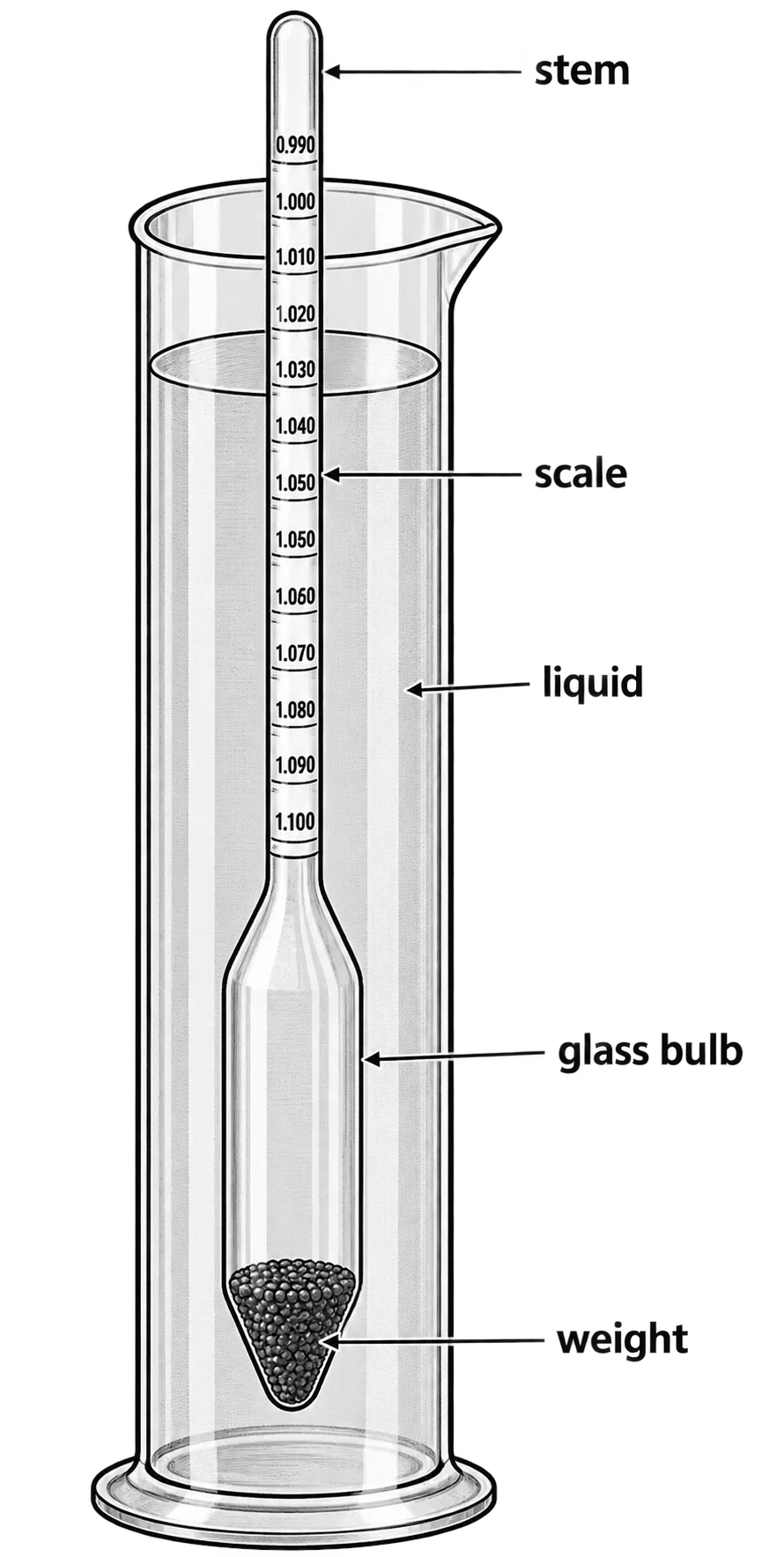
A hydrometer, a sealed glass tube weighted at the bottom with a calibrated scale printed along its narrow stem, floating upright in a liquid

A hydrometer floats higher (less of it submerged) in a denser liquid, and sinks lower (more of it submerged) in a less dense liquid — the same reason an object floats more easily in salty seawater than in fresh water. The scale is printed upside down (larger density values lower down the stem) so that the reading is taken where the liquid surface crosses the stem.
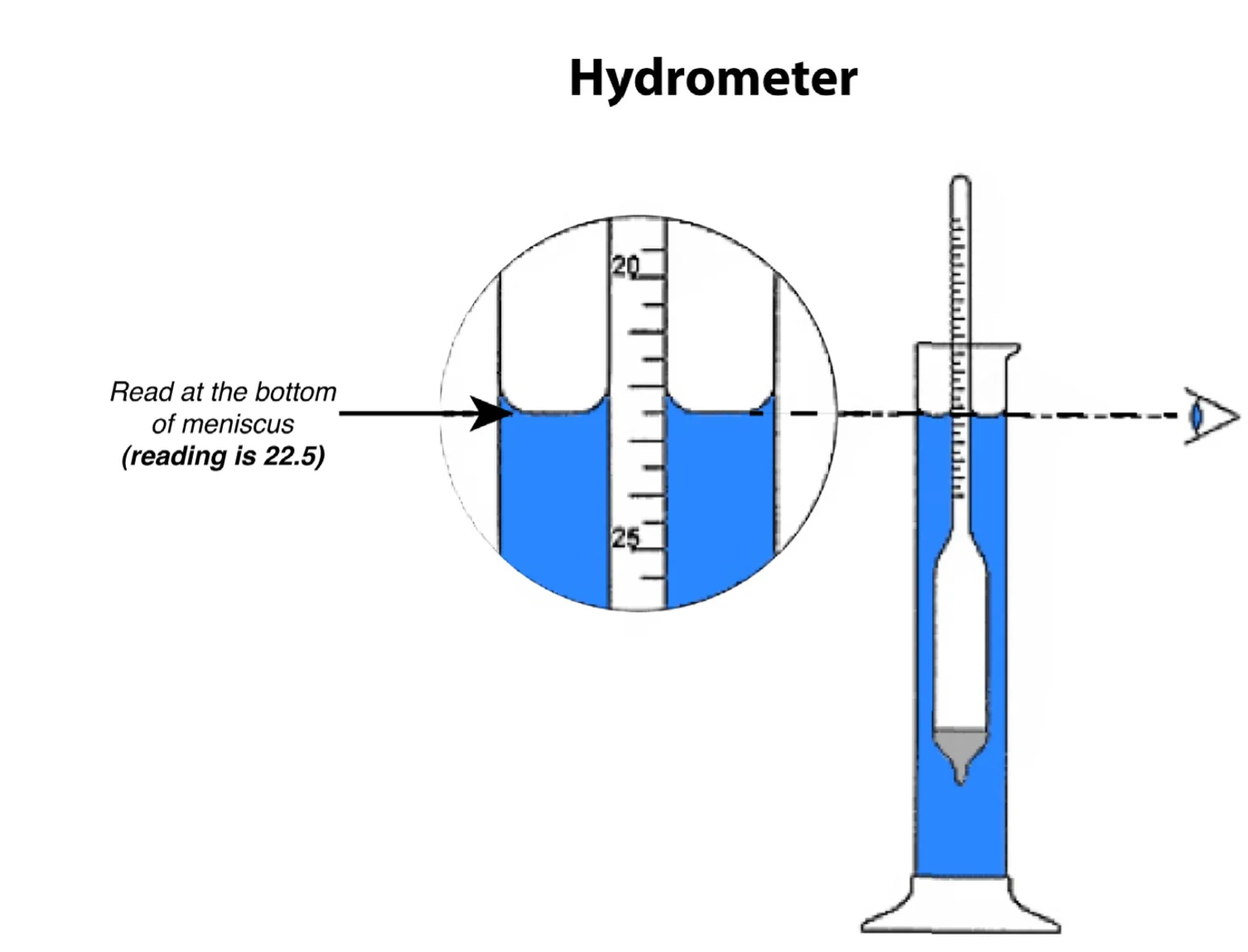
Close-up of a hydrometer's calibrated density scale, showing how the reading is taken level with the liquid surface

Density and buoyancy

Objects with a density greater than water (1 g/cm³) sink in water; objects with a density less than water float. This happens because of upthrust — an upward force exerted by a fluid (liquid or gas) on any object placed in it, caused by the fluid pushing back against the object. Buoyancy is an object's tendency to float, and depends on how the object's density compares with the density of the fluid it is in.

An object floats when the upthrust acting on it is equal to its weight; it sinks when its weight is greater than the maximum upthrust the fluid can provide. This is why a solid steel block sinks, yet a steel ship (whose overall shape displaces a much larger volume of water, most of it air-filled space) floats — its average density, spread over the whole hull shape, is less than that of water.
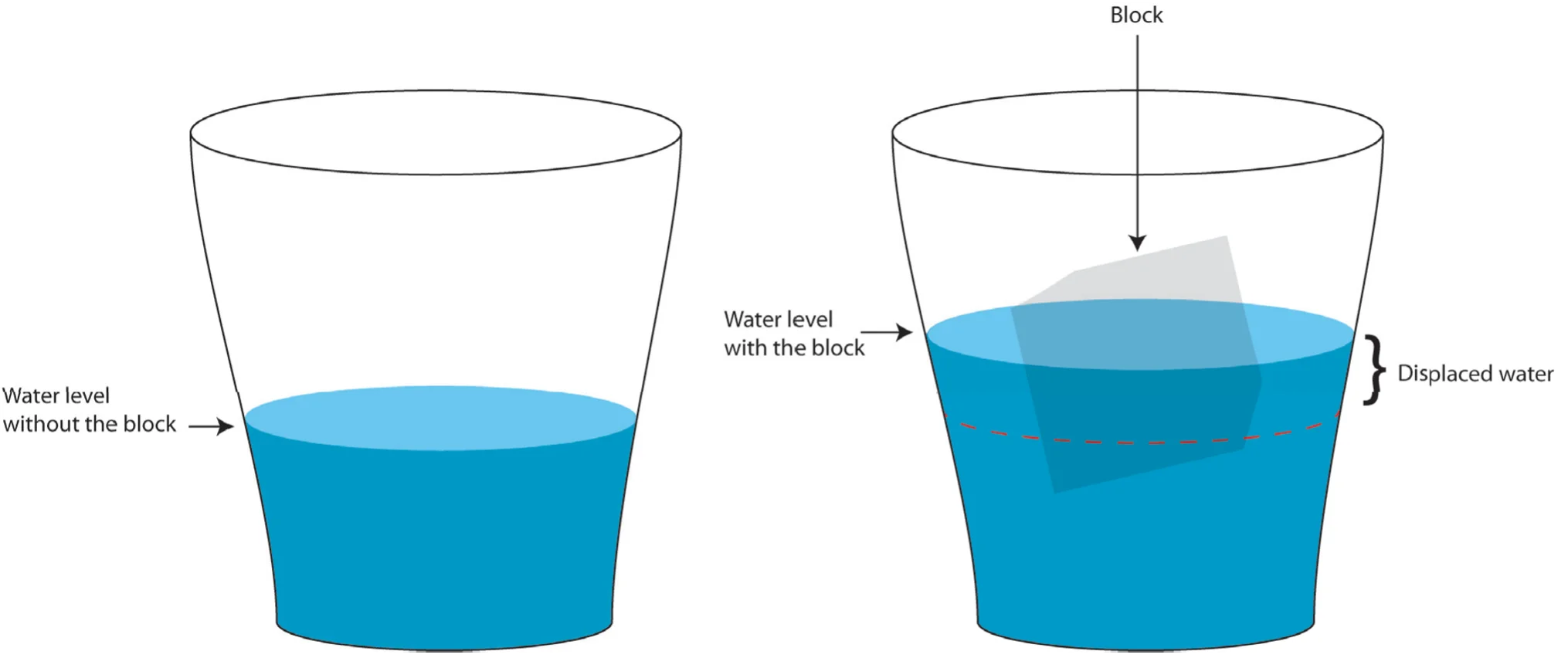
Diagram illustrating buoyancy and upthrust: an object submerged in a liquid experiences an upward upthrust force from the fluid, which balances its downward weight when the object floats

Measuring temperature

Temperature measures how hot or cold something is. Temperature is different from heat: heat is a form of energy that flows from a hotter object to a colder one, while temperature measures the average energy of the particles in a substance.

The SI unit of temperature is the kelvin (K). Two other commonly used units are the degree Celsius (°C) and the degree Fahrenheit (°F). All three scales measure the same thing, just with different zero points and different-sized degrees.

ScaleFreezing point of waterBoiling point of water
Kelvin (K)273 K373 K
Celsius (°C)0 °C100 °C
Fahrenheit (°F)32 °F212 °F

Conversions between the scales:

ConversionFormula
Celsius → KelvinK = °C + 273
Kelvin → Celsius°C = K − 273
Celsius → Fahrenheit°F = (°C × 9⁄5) + 32
Fahrenheit → Celsius°C = (°F − 32) × 5⁄9
Worked example — Celsius to Kelvin Normal human body temperature is 37 °C. Convert this to kelvin.

K = °C + 273 = 37 + 273 = 310 K
Worked example — Celsius to Fahrenheit Water boils at 100 °C. Convert this to degrees Fahrenheit.

°F = (°C × 9⁄5) + 32 = (100 × 9⁄5) + 32 = 180 + 32 = 212 °F
Worked example — Fahrenheit to Celsius A clinical thermometer reads 98.6 °F. Convert this to degrees Celsius.

°C = (°F − 32) × 5⁄9 = (98.6 − 32) × 5⁄9 = 66.6 × 5⁄9 = 37 °C
°C 0 25 50 75 100 273 298 323 348 373 K 37°C = 310 K
A mercury-in-glass thermometer: the liquid column expands as it heats up and rises up the narrow tube, and the reading (here 37 °C, or 310 K) is taken level with the top of the column.

Laboratory vs clinical thermometers

A laboratory thermometer and a clinical thermometer are both mercury/liquid-in-glass thermometers, but are designed for very different jobs:

Laboratory thermometerClinical thermometer
RangeWide, e.g. −10 °C to 110 °CNarrow, e.g. 35 °C to 42 °C (around body temperature)
PurposeGeneral experiments — boiling, freezing, reaction temperaturesMeasuring human body temperature only
PrecisionCoarser graduations, e.g. every 1 °CFine graduations, e.g. every 0.1 °C, for small but important changes
Constriction (kink)None — the liquid flows freely back down as it coolsHas a narrow constriction just above the bulb

The clinical thermometer's constriction is a deliberate narrowing of the tube just above the bulb. As the thermometer heats up in the patient's mouth or armpit, the liquid expands past the constriction; but once removed from the body and cooling, the liquid column breaks at the constriction and cannot flow back down, so the reading stays fixed long enough to be read accurately. Before reuse, the thermometer must be firmly shaken (or reset electronically) to force the liquid back down past the constriction.

Laboratory 1107030-10 Clinical constriction 423835
A laboratory thermometer covers a wide range for general experiments; a clinical thermometer covers only a narrow range around body temperature, with a constriction that holds the reading after removal.

Thermometers with small vs large bulbs

The size of a thermometer's bulb affects how it responds to temperature changes. A large bulb holds more liquid, so it produces a bigger, easier-to-read expansion for a given temperature change (more sensitive) — but it also takes longer to heat up or cool down to match its surroundings, giving a slower response time. A small bulb holds less liquid, so it heats up and cools down quickly, giving a faster response time — useful for measuring temperatures that change rapidly, even though each individual reading may be slightly less sensitive.

Small bulb fast response Large bulb slower, more sensitive
A small bulb responds quickly to temperature change but is less sensitive; a large bulb is more sensitive (bigger expansion per degree) but responds more slowly, since more liquid must heat up first.

Measuring time

Time is measured in seconds (s), the SI unit, using a stopwatch, stopclock, or ticker-timer, and is often used together with distance to calculate speed in scientific investigations. A digital stopwatch is generally more precise than an analogue one, often reading to 0.01 s.

00:12.45
A digital stopwatch measures time intervals precisely, typically to the nearest 0.01 s — far finer than a human can reliably react to.

Sources of error when timing an event by hand include:

Why timing by hand is unreliable

  • Reaction time — the short delay (roughly 0.2–0.3 s) between seeing an event start or finish and pressing the stopwatch button, which affects both the start and the stop of the timing
  • Parallax error — misreading a stopwatch or clock face because it is viewed from an angle rather than straight on
  • Zero error — a stopwatch that doesn't start exactly at zero, or a clock that runs fast or slow

Reaction time error can be reduced by timing multiple repeats and taking an average, or — better still — by timing several repetitions of a short event together and dividing by the number of repetitions.

Worked example — reducing timing error A single swing of a pendulum is too quick to time accurately by hand. Instead, a student times 20 complete swings, which take 30 s in total. Find the time for one swing.

Time for one swing = total time ÷ number of swings = 30 ÷ 20 = 1.5 s

Any reaction-time error in starting and stopping the stopwatch is now spread across 20 swings instead of 1, making the result far more reliable.

When no timing device is available, time can be roughly estimated using a known steady rhythm, such as counting seconds aloud ("one-Mississippi, two-Mississippi…"), counting a resting heartbeat (about 1 beat per second, or roughly 70–80 beats per minute in an adult), or comparing against a familiar recurring event, such as how long a traffic light usually stays red. Estimated time is far less reliable than a measured time and should only be used when no timing instrument is available.

Lesson 5: Information and Communication Technology (ICT)

ICT refers to technologies used to store, process, retrieve, and communicate information, including computers, mobile phones, the internet, and software applications.

ICT plays an important role in science and everyday life: data logging uses sensors and computers to automatically record scientific measurements over time (e.g. temperature or light levels); simulations allow scientists to model processes that would be too dangerous, slow, or expensive to test in real life; and databases and the internet allow scientific information to be shared and accessed quickly worldwide.

Uses of ICT in Botswana include mobile banking, e-learning platforms, weather forecasting systems, and electronic health records in hospitals and clinics.

Responsible use of ICT includes protecting personal information, verifying the reliability of online sources, and being aware of risks such as cyberbullying and the spread of false information.

Media for communicating scientific knowledge

Scientific knowledge is shared through a range of media, each suited to a different audience and purpose:

MediumTypical use
Scientific journals & papersDetailed, peer-reviewed findings shared between scientists
Textbooks & encyclopaediasEstablished, well-tested knowledge for learners
Television & radioDocumentaries and news reaching a broad public audience
Internet & social mediaFast, wide-reaching, but of very mixed reliability
Conferences & presentationsScientists sharing new findings directly with peers

Peer review — where other scientists check a study's methods and conclusions before it is published — is what makes a scientific journal more trustworthy than an unchecked social media post, even though both may reach the public through the internet.

The impact of technology on society

Technology developed from scientific knowledge has transformed how people live and work. Positive impacts include improved healthcare (vaccines, diagnostic scanners, mobile clinics), increased farming yields (irrigation technology, fertilisers, weather forecasting), faster communication and transport, and access to information and education through computers and mobile devices.

Technology can also bring negative impacts: job losses where automation replaces manual labour, environmental damage from industrial processes and e-waste, overreliance on technology, and unequal access between those who can afford new technology and those who cannot (the digital divide).

Cultural impact of global communication

Global communication technology (the internet, satellite television, mobile phones) has connected cultures worldwide, allowing ideas, languages, music, and traditions to spread and be shared far beyond their place of origin. In Botswana, this has meant greater exposure to global trends and knowledge, alongside the ability to share Setswana culture and languages with the rest of the world.

This exchange has both benefits (learning from other cultures, international collaboration in science, cultural exchange and tourism) and risks (smaller or minority cultures and languages being overshadowed by dominant global media, and the spread of misinformation across borders faster than it can be checked).

Careers in ICT

The growth of ICT has created a wide range of careers, including: software developer (designing and writing computer programs and apps), network engineer (building and maintaining computer networks and internet connections), data analyst (interpreting large sets of data to find patterns and inform decisions), cybersecurity specialist (protecting computer systems and data from unauthorised access), and ICT technician (installing, maintaining, and repairing computer hardware and software). These careers are increasingly in demand in Botswana as government, schools, banks, and businesses continue to digitise their services.

Topic 2

Living Things & the Environment

There's more where that came from ✨

Subscribe and get everything, for every topic:

✅ Full notes, every topic ✅ All exam questions ✅ Flashcards & diagrams ✅ New content first
Unlock full access →

Topic 3

Materials & their Properties

There's more where that came from ✨

Subscribe and get everything, for every topic:

✅ Full notes, every topic ✅ All exam questions ✅ Flashcards & diagrams ✅ New content first
Unlock full access →

Topic 4

Sexual Reproductive Health

There's more where that came from ✨

Subscribe and get everything, for every topic:

✅ Full notes, every topic ✅ All exam questions ✅ Flashcards & diagrams ✅ New content first
Unlock full access →

Topic 5

Forces and Energy

There's more where that came from ✨

Subscribe and get everything, for every topic:

✅ Full notes, every topic ✅ All exam questions ✅ Flashcards & diagrams ✅ New content first
Unlock full access →

Topic 6

Forces, Motion and Energy

There's more where that came from ✨

Subscribe and get everything, for every topic:

✅ Full notes, every topic ✅ All exam questions ✅ Flashcards & diagrams ✅ New content first
Unlock full access →

Topic 7

Health and Safety

There's more where that came from ✨

Subscribe and get everything, for every topic:

✅ Full notes, every topic ✅ All exam questions ✅ Flashcards & diagrams ✅ New content first
Unlock full access →

Topic 8

The Human Body

There's more where that came from ✨

Subscribe and get everything, for every topic:

✅ Full notes, every topic ✅ All exam questions ✅ Flashcards & diagrams ✅ New content first
Unlock full access →

Topic 9

Electricity and Magnetism

There's more where that came from ✨

Subscribe and get everything, for every topic:

✅ Full notes, every topic ✅ All exam questions ✅ Flashcards & diagrams ✅ New content first
Unlock full access →

Flashcards

Key Terms

TermHypothesis
DefinitionA testable prediction made before an experiment, based on prior knowledge or observation.
TermFair test
DefinitionAn experiment where only one variable is changed at a time while all others are kept constant.
TermIndependent variable
DefinitionThe one factor that is deliberately changed in an experiment.
TermDependent variable
DefinitionThe factor that is measured or observed, which may change as a result of the independent variable.
TermControlled variable
DefinitionA factor that is kept the same throughout an experiment to ensure a fair test.
TermHazard
DefinitionAnything with the potential to cause harm (as opposed to risk, the chance that it actually will).
TermCorrosive
DefinitionA hazard symbol warning that a substance can destroy living tissue or materials on contact, e.g. strong acids and alkalis.
TermMeniscus
DefinitionThe curved surface of a liquid, read at eye level for an accurate volume measurement.
TermScalar quantity
DefinitionA quantity with magnitude (size) only, e.g. distance, mass, speed, time.
TermVector quantity
DefinitionA quantity with both magnitude and direction, e.g. displacement, velocity, force.
TermDisplacement method
DefinitionFinding the volume of an irregular solid by measuring the rise in water level when it is fully submerged.
TermAccuracy
DefinitionHow close a measurement is to the true value.
TermPrecision
DefinitionHow consistent repeated measurements are with each other.
TermDensity
DefinitionMass ÷ Volume, a measure of how much mass is packed into a given space.
TermTemperature
DefinitionA measure of how hot or cold something is, measured in degrees Celsius.
TermHydrometer
DefinitionA floating instrument with a calibrated scale used to measure the density of a liquid directly.
TermUpthrust
DefinitionThe upward force a fluid exerts on an object placed in it; an object floats when upthrust equals its weight.
TermKelvin (K)
DefinitionThe SI unit of temperature. K = °C + 273.
TermConstriction
DefinitionA narrowing in a clinical thermometer's tube, just above the bulb, that stops the liquid flowing back so the reading can be taken after removal.
TermReaction time (timing error)
DefinitionThe short delay between an event happening and a person pressing a stopwatch, a major source of error in manual timing.
TermICT
DefinitionInformation and Communication Technology, used to store, process, and share information.
TermData logging
DefinitionUsing sensors and computers to automatically record scientific measurements over time.
TermPeer review
DefinitionThe process where other scientists check a study's methods and conclusions before it is published, making journals more trustworthy than unchecked sources.
TermDigital divide
DefinitionThe unequal access to technology between those who can afford it and those who cannot.
TermMRS GREN
DefinitionAn acronym for the seven characteristics of living things: Movement, Respiration, Sensitivity, Growth, Reproduction, Excretion, Nutrition.
TermVertebrate
DefinitionAn animal with a backbone, e.g. fish, reptiles, mammals.
TermInvertebrate
DefinitionAn animal without a backbone, e.g. insects, worms, molluscs.
TermPhotosynthesis
DefinitionThe process by which green plants use sunlight to convert carbon dioxide and water into glucose.
TermProducer
DefinitionAn organism, usually a green plant, that makes its own food using sunlight.
TermConsumer
DefinitionAn organism that obtains energy by eating other organisms.
TermDecomposer
DefinitionAn organism, such as fungi or bacteria, that breaks down dead matter and returns nutrients to the soil.
TermFood chain
DefinitionA diagram showing the transfer of energy from one organism to the next in a straight line.
TermFood web
DefinitionA diagram showing how multiple interconnected food chains overlap in an ecosystem.
TermTrophic level
DefinitionA stage in a food chain; only about 10% of energy passes from one trophic level to the next.
TermRenewable resource
DefinitionA natural resource that can be replaced naturally within a human lifetime, e.g. water or forests.
TermNon-renewable resource
DefinitionA natural resource that takes millions of years to form and cannot be replaced once used up, e.g. coal or minerals.
TermConservation
DefinitionUsing natural resources wisely so they last for future generations.
TermEcosystem
DefinitionA community of living organisms interacting with each other and their physical environment.
TermBiotic and abiotic factors
DefinitionBiotic factors are living components of an ecosystem; abiotic factors are non-living components like sunlight and water.
TermPollination
DefinitionThe transfer of pollen from the anther to the stigma of a flower.
TermFertilisation (plants)
DefinitionWhen the male sex cell from pollen joins with the female sex cell in the ovule.
TermSeed dispersal
DefinitionThe spreading of seeds away from the parent plant, reducing competition for resources.
TermGenetic modification
DefinitionChanging the genetic material of an organism, often by inserting a gene from another organism.
TermSelective breeding
DefinitionDeliberately breeding organisms with desired characteristics together over many generations.
TermMatter
DefinitionAnything that has mass and takes up space (volume).
TermMelting
DefinitionThe change of state from solid to liquid.
TermEvaporation
DefinitionThe change of state from liquid to gas.
TermCondensation
DefinitionThe change of state from gas to liquid.
TermSublimation
DefinitionThe change of state directly from solid to gas, without becoming liquid.
TermParticle theory of matter
DefinitionThe idea that particles move faster and have more energy as temperature increases.
TermNitrogen in air
DefinitionMakes up about 78% of air by volume; relatively unreactive and used by plants via nitrogen-fixing bacteria.
TermOxygen in air
DefinitionMakes up about 21% of air by volume; essential for respiration and combustion.
TermLimewater test
DefinitionLimewater turns cloudy (milky) in the presence of carbon dioxide.
TermGlowing splint test
DefinitionA glowing splint relights in the presence of oxygen.
TermAcid
DefinitionA substance that produces hydrogen ions in water and has a pH less than 7.
TermBase / Alkali
DefinitionA substance that neutralises an acid; an alkali is a base that dissolves in water.
TermpH scale
DefinitionA scale from 0 to 14 measuring acidity/alkalinity; 7 is neutral.
TermNeutralisation
DefinitionA reaction between an acid and a base to form a salt and water.
TermMalleable
DefinitionAble to be hammered or pressed into sheets without breaking; a property of metals.
TermReactivity series
DefinitionAn order of metals based on how vigorously they react with water, acids, and oxygen.
TermAlloy
DefinitionA mixture of a metal with one or more other elements, made to improve its properties.
TermElement
DefinitionA pure substance made of only one type of atom.
TermCompound
DefinitionA substance formed when two or more elements chemically combine in fixed proportions.
TermMixture
DefinitionTwo or more substances physically combined (not chemically bonded), separable by physical methods.
TermChromatography
DefinitionA technique for separating substances in a mixture based on how they move through a material.
TermDurability
DefinitionThe ability of a material to last a long time without significant wear.
TermGametes
DefinitionSex cells; ova in females and sperm in males.
TermOvulation
DefinitionThe release of an ovum, occurring during the menstrual cycle.
TermMenstrual cycle
DefinitionA cycle of approximately 28 days, regulated by oestrogen and progesterone, that repeats until menopause.
TermFertilisation
DefinitionWhen a sperm and an ovum meet to form a zygote; also called conception or fusion.
TermStages of foetal development
DefinitionIn order: Zygote, Morula, Blastula, Embryo, Foetus.
TermLabour
DefinitionThe process of childbirth, involving contractions, release of amniotic fluid, and delivery of the baby and afterbirth.
TermAntenatal care
DefinitionMedical care received during pregnancy to keep mother and baby healthy.
TermSTI
DefinitionSexually transmitted infection, passed from person to person through unprotected sexual intercourse.
TermHIV and AIDS
DefinitionHIV is the virus; AIDS is the disease it causes, marked by opportunistic infections such as TB or pneumonia.
TermOpportunistic diseases
DefinitionDiseases such as cancer, pneumonia, and tuberculosis that appear when a person has full-blown AIDS.
TermLaw of Conservation of Energy
DefinitionEnergy cannot be created or destroyed, only transformed or transferred.
TermKinetic energy
DefinitionEnergy of movement.
TermGravitational potential energy
DefinitionEnergy stored due to an object's height above the ground.
TermAmplitude
DefinitionThe size of a sound wave's vibration, which determines loudness.
TermFrequency
DefinitionThe number of vibrations per second, measured in hertz, which determines pitch.
TermForce
DefinitionA push or pull that can change the shape, speed, or direction of an object, measured in newtons.
TermFriction
DefinitionA force that opposes motion between two surfaces in contact.
TermResultant force
DefinitionThe overall (net) force acting on an object when all forces are combined.
TermPressure
DefinitionForce ÷ Area, measured in pascals.
TermAtmospheric pressure
DefinitionThe pressure exerted by the weight of air in the Earth's atmosphere.
TermSpeed
DefinitionDistance ÷ Time, a measure of how fast an object is moving.
TermVelocity
DefinitionSpeed in a given direction; a vector quantity.
TermAcceleration
DefinitionThe rate of change of velocity, measured in m/s².
TermDistance-time graph
DefinitionA graph whose gradient represents speed.
TermReflection
DefinitionLight bouncing off a surface; angle of incidence equals angle of reflection.
TermRefraction
DefinitionThe bending of light as it passes from one transparent medium into another.
TermLuminous object
DefinitionAn object that produces its own light, e.g. the sun.
TermShadow
DefinitionForms when an opaque object blocks the path of light.
TermConduction
DefinitionHeat transfer through direct contact between particles, most effective in solids.
TermConvection
DefinitionHeat transfer through the movement of a fluid (liquid or gas).
TermRadiation (heat)
DefinitionHeat transfer as electromagnetic waves, not requiring a medium.
TermThermal expansion
DefinitionThe increase in size of a substance as it is heated.
TermMachine
DefinitionA device that makes work easier by changing the size or direction of a force.
TermFulcrum
DefinitionThe fixed point around which a lever pivots.
TermMechanical advantage
DefinitionOutput force (load) ÷ Input force (effort); the factor by which a machine multiplies force.
TermFirst-class lever
DefinitionA lever where the fulcrum is between the load and the effort, e.g. a see-saw.
TermEnamel
DefinitionThe hard, white, outer protective layer of a tooth; the hardest substance in the human body.
TermPlaque
DefinitionA sticky film of bacteria that forms on teeth.
TermPathogen
DefinitionA microorganism that causes disease, e.g. bacteria, viruses, fungi, protozoa.
TermCommunicable disease
DefinitionA disease that can be passed from one person or animal to another.
TermVector
DefinitionA carrier organism that spreads disease, e.g. a mosquito transmitting malaria.
TermVaccination
DefinitionA method of helping the body build immunity to a specific pathogen before infection occurs.
TermCross-contamination
DefinitionThe transfer of harmful bacteria from one food (usually raw) to another.
TermFood preservation
DefinitionMethods that slow or prevent food spoilage by creating conditions microorganisms cannot easily grow in.
TermFood spoilage
DefinitionThe breakdown of food by microorganisms, making it unsafe or unpleasant to eat.
TermSanitation
DefinitionFacilities and practices (e.g. clean toilets, proper waste disposal) that maintain a hygienic environment.
TermBalanced diet
DefinitionA diet containing the correct proportions of all essential nutrients needed for good health.
TermMalnutrition
DefinitionA condition caused by a diet lacking essential nutrients.
TermKwashiorkor
DefinitionA deficiency disease caused by lack of protein, common in young children.
TermDrug
DefinitionAny substance that changes the way the body or mind functions when taken.
TermDependence (addiction)
DefinitionA condition where the body or mind relies on a drug, making it difficult to stop using it.
TermTolerance
DefinitionWhen increasingly larger doses of a drug are needed to achieve the same effect over time.
TermWithdrawal symptoms
DefinitionPhysical or mental effects experienced when stopping drug use after dependence has developed.
TermArtery
DefinitionA blood vessel that carries blood away from the heart, with thick, muscular walls.
TermVein
DefinitionA blood vessel that carries blood back to the heart, containing valves to prevent backflow.
TermCapillary
DefinitionA tiny blood vessel with thin walls that allows exchange of substances between blood and tissues.
TermRed blood cell
DefinitionA blood cell that carries oxygen using haemoglobin.
TermAlveoli
DefinitionTiny air sacs in the lungs where gas exchange with the blood takes place.
TermDiaphragm
DefinitionA muscle beneath the lungs that contracts and flattens during inhalation.
TermExcretion
DefinitionThe removal of waste products made by the body's own metabolic processes.
TermUrea
DefinitionA waste product formed from the breakdown of excess protein, removed by the kidneys.
TermKidneys
DefinitionOrgans that filter the blood to remove waste products, excess water, and salts, forming urine.
TermReflex action
DefinitionA fast, automatic, involuntary response to a stimulus that does not require conscious thought.
TermHormone
DefinitionA chemical messenger released by a gland directly into the bloodstream.
TermInsulin
DefinitionA hormone produced by the pancreas that regulates blood sugar levels.
TermBall-and-socket joint
DefinitionA joint that allows movement in almost all directions, e.g. the hip or shoulder.
TermLigament
DefinitionTough, elastic tissue connecting bone to bone at a joint.
TermTendon
DefinitionStrong tissue connecting muscle to bone.
TermAntagonistic pair
DefinitionA pair of muscles that work opposite each other to move a joint, e.g. biceps and triceps.
TermMagnetic field
DefinitionThe region around a magnet where its magnetic force can be detected.
TermLike poles / Unlike poles
DefinitionLike poles repel each other; unlike poles attract each other.
TermElectric current
DefinitionThe rate of flow of electric charge, measured in amperes.
TermVoltage
DefinitionA measure of the energy given to charge as it flows, measured in volts.
TermResistance
DefinitionA measure of how much a component opposes the flow of current, measured in ohms.
TermOhm's Law
DefinitionVoltage = Current × Resistance (V = IR).
TermElectrical power formula
DefinitionPower = Voltage × Current (P = VI), measured in watts.
TermSeries circuit
DefinitionA circuit where components are connected in a single loop; if one fails, the whole circuit stops.
TermParallel circuit
DefinitionA circuit where components are connected across separate branches; each can work independently.
TermConductor (electrical)
DefinitionA material that allows electric current to flow easily, e.g. copper.

Topic 1

Science, Technology & Society

1
3 marks
Describe the steps of the scientific method, in order.
Model answerMake an observation, form a hypothesis, carry out an experiment to test it, record and analyse results, and draw a conclusion.
2
2 marks
A student is investigating how temperature affects the rate a sugar cube dissolves. Identify the independent variable and the dependent variable.
Model answerIndependent variable: temperature of the water. Dependent variable: time taken for the sugar cube to dissolve.
3
2 marks
State two safety rules that should be followed in a science laboratory.
Model answerAlways wear safety goggles when handling chemicals; never taste or smell chemicals directly (tying back long hair, and not eating/drinking in the lab, are also acceptable).
4
3 marks
A chemical bottle is labelled with a skull-and-crossbones symbol inside a red diamond. Name this hazard symbol and explain what it warns a user about. State one precaution that should be taken when using this chemical.
Model answerToxic symbol — it warns that the substance can cause death or serious harm if swallowed, inhaled, or absorbed through the skin. Precaution: wear gloves and avoid inhaling fumes (working in a fume cupboard or well-ventilated area is also acceptable).
5
2 marks
Distinguish between a hazard and a risk, using an example.
Model answerA hazard is anything with the potential to cause harm (e.g. a Bunsen burner flame); a risk is the chance that it will actually cause harm (e.g. the risk of a burn is high if loose sleeves are worn near the flame, but low if sleeves are rolled up).
6
2 marks
State the SI unit and a suitable instrument for measuring mass.
Model answerSI unit: kilogram (kg). Instrument: a balance (beam or electronic).
7
2 marks
Explain the difference between a scalar quantity and a vector quantity, giving one example of each.
Model answerA scalar has magnitude only, e.g. speed or mass. A vector has both magnitude and direction, e.g. velocity or force.
8
2 marks
A measuring cylinder contains 40 cm³ of water. A metal bolt is lowered in and the level rises to 55 cm³. State the method used and calculate the volume of the bolt.
Model answerDisplacement method. Volume of bolt = 55 − 40 = 15 cm³.
9
2 marks
A rectangular field measures 30 m by 12 m. Calculate its area.
Model answerArea = length × width = 30 × 12 = 360 m².
10
3 marks
A block of wood has a mass of 90 g and a volume of 100 cm³. Calculate its density, and state whether it will float or sink in water.
Model answerDensity = 90 ÷ 100 = 0.9 g/cm³. Since this is less than the density of water (1 g/cm³), the block will float.
11
2 marks
Explain the difference between accuracy and precision in measurement.
Model answerAccuracy is how close a measurement is to the true value; precision is how consistent repeated measurements are with each other, regardless of whether they are correct.
12
2 marks
Describe how a hydrometer is used to find the density of a liquid.
Model answerThe hydrometer is floated freely in the liquid; the density is read directly off its calibrated scale at the point where the liquid surface meets the stem. It floats higher in denser liquids and lower in less dense liquids.
13
2 marks
Explain, in terms of upthrust, why a steel ship floats even though a solid block of steel sinks.
Model answerThe ship's hull shape displaces a much larger volume of water than a solid block of the same mass would, so the upthrust on it is large enough to equal its weight; a solid block's weight is greater than the maximum upthrust it can experience, so it sinks.
14
2 marks
Convert 25 °C to kelvin, and convert 0 °C to degrees Fahrenheit.
Model answerK = 25 + 273 = 298 K. °F = (0 × 9⁄5) + 32 = 32 °F.
15
3 marks
Give two differences between a laboratory thermometer and a clinical thermometer.
Model answerAny two: a laboratory thermometer has a much wider range (e.g. −10 °C to 110 °C) than a clinical thermometer (e.g. 35–42 °C); a clinical thermometer has a constriction just above the bulb to hold the reading after removal, which a laboratory thermometer does not; a clinical thermometer has finer graduations suited to small body-temperature changes.
16
2 marks
A student times 20 swings of a pendulum and finds this takes 25 seconds. Calculate the time for one swing, and explain why timing 20 swings gives a more reliable result than timing a single swing.
Model answerTime for one swing = 25 ÷ 20 = 1.25 s. Timing 20 swings spreads the reaction-time error in starting and stopping the stopwatch across many swings instead of just one, reducing its effect on the final result.
17
2 marks
State one benefit and one risk of global communication technology spreading culture and information between countries.
Model answerBenefit: cultures and scientific knowledge can be shared and learned from worldwide. Risk: smaller or minority cultures and languages can be overshadowed by dominant global media (misinformation spreading quickly across borders is also acceptable).
18
3 marks
State one way ICT is used in scientific investigations, and one benefit it provides.
Model answerData logging — sensors and computers automatically record measurements over time, allowing continuous, accurate data collection without a person having to be present.

Topic 2

Living Things & the EnvironmentLiving Things & the Environment

There's more where that came from ✨

Subscribe and get everything, for every topic:

✅ Full notes, every topic ✅ All exam questions ✅ Flashcards & diagrams ✅ New content first
Unlock full access →

Topic 3

Materials & their PropertiesMaterials & their Properties

There's more where that came from ✨

Subscribe and get everything, for every topic:

✅ Full notes, every topic ✅ All exam questions ✅ Flashcards & diagrams ✅ New content first
Unlock full access →

Topic 4

Sexual Reproductive HealthSexual Reproductive Health

There's more where that came from ✨

Subscribe and get everything, for every topic:

✅ Full notes, every topic ✅ All exam questions ✅ Flashcards & diagrams ✅ New content first
Unlock full access →

Topic 5

Forces and EnergyForces and Energy

There's more where that came from ✨

Subscribe and get everything, for every topic:

✅ Full notes, every topic ✅ All exam questions ✅ Flashcards & diagrams ✅ New content first
Unlock full access →

Topic 6

Forces, Motion and EnergyForces, Motion and Energy

There's more where that came from ✨

Subscribe and get everything, for every topic:

✅ Full notes, every topic ✅ All exam questions ✅ Flashcards & diagrams ✅ New content first
Unlock full access →

Topic 7

Health and SafetyHealth and Safety

There's more where that came from ✨

Subscribe and get everything, for every topic:

✅ Full notes, every topic ✅ All exam questions ✅ Flashcards & diagrams ✅ New content first
Unlock full access →

Topic 8

The Human BodyThe Human Body

There's more where that came from ✨

Subscribe and get everything, for every topic:

✅ Full notes, every topic ✅ All exam questions ✅ Flashcards & diagrams ✅ New content first
Unlock full access →

Topic 9

Electricity and MagnetismElectricity and Magnetism

There's more where that came from ✨

Subscribe and get everything, for every topic:

✅ Full notes, every topic ✅ All exam questions ✅ Flashcards & diagrams ✅ New content first
Unlock full access →

Mock Exams & Past Papers

Full Papers

Two full-length mock papers in the JCE Science exam style, drawing on every topic covered above. Work through each under timed conditions, then reveal each answer to mark yourself.

Paper 1 — Scientific Skills, Biology and Chemistry

Time allowed: 1 hour 30 minutes  •  Total marks: 50

Instructions

  • Answer all questions in Sections A, B and C.
  • Show all working for any calculation.
  • Section A carries 20 marks, Section B carries 20 marks, and Section C carries 10 marks.

Section A — Scientific Skills and Measurement (20 marks)

1
3 marks
A student wants to investigate whether the concentration of fertiliser affects the height of bean plants. State the independent variable, the dependent variable, and one variable that must be controlled.
Model answerIndependent variable: concentration of fertiliser. Dependent variable: height of the bean plants. Controlled variable (any one): amount of water given, type of soil, amount of sunlight, or bean variety used.
2
2 marks
Name the hazard symbol that appears on a bottle of concentrated sulfuric acid, and state what it warns the user about.
Model answerCorrosive symbol — it warns that the substance can destroy living tissue (e.g. skin, eyes) and other materials on contact.
3
3 marks
A measuring cylinder contains 60 cm³ of water. A small rock is lowered in and the level rises to 88 cm³. Name this method and calculate the volume of the rock.
Model answerDisplacement method. Volume of rock = 88 − 60 = 28 cm³.
4
3 marks
A metal cube has sides of 4 cm and a mass of 320 g. Calculate its density, and state whether it would sink or float in water.
Model answerVolume = 4 × 4 × 4 = 64 cm³. Density = 320 ÷ 64 = 5 g/cm³. Since this is greater than the density of water (1 g/cm³), the cube would sink.
5
2 marks
Convert 45 °C to kelvin, and convert 100 °C to degrees Fahrenheit.
Model answerK = 45 + 273 = 318 K. °F = (100 × 9⁄5) + 32 = 212 °F.
6
3 marks
Explain why a clinical thermometer has a constriction just above its bulb, while a laboratory thermometer does not.
Model answerThe constriction stops the liquid flowing back down once the thermometer is removed from the patient's body, holding the reading steady long enough to be read accurately. A laboratory thermometer is used to follow changing temperatures during an experiment, so its liquid must be free to rise and fall continuously.
7
2 marks
A student times 20 oscillations of a pendulum and records 24 seconds. Calculate the time for one oscillation, and explain why this method is more reliable than timing a single oscillation.
Model answerTime for one oscillation = 24 ÷ 20 = 1.2 s. Timing 20 oscillations spreads the reaction-time error from starting and stopping the stopwatch across many oscillations, reducing its effect on the final result.
8
2 marks
State one benefit and one risk associated with global communication technology.
Model answerBenefit: ideas, scientific knowledge, and culture can be shared quickly worldwide. Risk: misinformation can also spread quickly across borders before it can be checked (a smaller culture being overshadowed by dominant global media is also acceptable).

Section B — Living Things, the Environment and the Human Body (20 marks)

9
4 marks
State two ways energy is lost between each stage of a food chain, and explain why food chains rarely have more than four or five trophic levels.
Model answerEnergy is lost as heat through respiration, and lost in materials the organism cannot digest (e.g. bones, faeces) or in parts not eaten by the next consumer. Because roughly 90% of energy is lost at each stage, there is too little energy left to support further trophic levels after four or five steps.
10
3 marks
Explain one way that overgrazing can damage the environment, and suggest one way farmers can manage this resource sustainably.
Model answerOvergrazing strips the land of vegetation, exposing the soil to wind and water erosion and reducing its ability to support future plant growth. Sustainable management: rotational grazing, moving livestock between camps to allow grazed land time to recover.
11
3 marks
Describe the pathway of air from the nose to the lungs during breathing in, naming the structures in order.
Model answerNose/mouth → trachea → bronchi → bronchioles → alveoli, where gas exchange takes place.
12
3 marks
Name the organ responsible for filtering waste from the blood, name the main waste product it removes, and state where this waste is stored before being released from the body.
Model answerKidneys filter the blood, removing urea (and excess water/salts) to form urine. Urine is stored in the bladder before being released.
13
4 marks
A child is diagnosed with kwashiorkor. Name the nutrient deficiency responsible, describe two symptoms, and suggest one dietary change that would help.
Model answerProtein deficiency. Symptoms: swelling (oedema, especially of the belly and limbs) and stunted growth. Dietary change: increase intake of protein-rich foods such as beans, eggs, fish, or milk.
14
3 marks
Explain how vaccination helps prevent the spread of a communicable disease.
Model answerA vaccine exposes the body to a weakened or harmless form of a pathogen, causing the immune system to produce antibodies against it. If the person later encounters the real pathogen, their immune system can respond quickly, usually preventing them from becoming ill and from passing the disease on to others.

Section C — Materials and their Properties (10 marks)

15
4 marks
Sorghum porridge is left in a warm room for several hours before it is thrown away for tasting sour. Explain, in terms of particles/microorganisms, what has happened, and suggest one food preservation method that would have prevented this.
Model answerMicroorganisms (bacteria/moulds) present in the food grew rapidly in the warm, moist conditions, breaking down the food and producing acids and other substances that make it taste sour and become unsafe to eat. Refrigeration (or any correct method: drying, salting, canning, smoking) would have slowed or prevented this microbial growth.
16
3 marks
State one physical property that distinguishes a metal from a non-metal, and give one everyday use of a metal that relies on this property.
Model answerMetals conduct electricity well (non-metals generally do not). Use: copper wiring in household electrical cables relies on copper's good electrical conductivity.
17
3 marks
A solution turns universal indicator blue. State whether it is acidic, neutral, or alkaline, and estimate its approximate pH range.
Model answerAlkaline — a blue/purple colour on universal indicator corresponds to a pH of roughly 10–14.

Paper 2 — Forces, Energy, Electricity and Health

Time allowed: 2 hours  •  Total marks: 50

Instructions

  • Answer all questions in Sections A, B and C.
  • Show all working for any calculation, including the formula used.
  • Section A carries 20 marks, Section B carries 20 marks, and Section C carries 10 marks.

Section A — Forces, Motion and Energy (20 marks)

1
3 marks
A trolley travels 15 m in 3 seconds at a steady speed. Calculate its speed, stating the formula used and the correct unit.
Model answerSpeed = distance ÷ time = 15 ÷ 3 = 5 m/s.
2
3 marks
A force of 20 N acts on an object with a mass of 4 kg. Calculate the acceleration produced, stating the formula used.
Model answerForce = mass × acceleration, so acceleration = Force ÷ mass = 20 ÷ 4 = 5 m/s².
3
2 marks
A woman of weight 600 N stands on both feet, and the total area of contact with the ground is 300 cm². Calculate the pressure she exerts on the ground.
Model answerPressure = Force ÷ Area = 600 ÷ 300 = 2 N/cm².
4
3 marks
Explain, using the idea of energy transfer, what happens when a ball is thrown straight up into the air and falls back down.
Model answerAs the ball rises, its kinetic energy is transferred to gravitational potential energy, slowing it down until it momentarily stops at the highest point. As it falls back down, this potential energy is transferred back into kinetic energy, so the ball speeds up.
5
3 marks
A sound wave travels through air but cannot travel through a vacuum. Explain why, referring to particles.
Model answerSound travels as a vibration passed from particle to particle in a medium such as air; a vacuum contains no particles, so there is nothing to vibrate and pass the sound energy along.
6
3 marks
Name the three states of matter and describe, in terms of particle arrangement, the difference between a liquid and a gas.
Model answerSolid, liquid, gas. In a liquid, particles are close together and can move/slide past each other; in a gas, particles are far apart and move freely and randomly in all directions.
7
3 marks
A simple machine allows a person to lift a 400 N load using an effort of only 100 N. Calculate the mechanical advantage of the machine.
Model answerMechanical advantage = load ÷ effort = 400 ÷ 100 = 4.

Section B — Electricity and Magnetism (20 marks)

8
3 marks
State two properties of magnets, and describe a simple test to determine whether an unmarked bar is a magnet or just an unmagnetised piece of iron.
Model answerAny two: magnets have two poles (north and south); like poles repel and unlike poles attract; magnets attract magnetic materials (iron, steel, cobalt, nickel). Test: bring one end of the bar close to a known magnet's pole — if it repels in at least one orientation, it is a magnet (attraction alone is not proof, since an unmagnetised magnetic material would also be attracted).
9
3 marks
Explain the difference between a series circuit and a parallel circuit in terms of what happens to the other components when one bulb blows.
Model answerIn a series circuit, if one bulb blows (breaking the circuit), all other components stop working because there is only one path for current to flow. In a parallel circuit, each component has its own separate path, so if one bulb blows, the others continue working normally.
10
3 marks
A current of 2 A flows through a bulb connected to a 12 V supply. Calculate the resistance of the bulb, stating the formula used.
Model answerResistance = Voltage ÷ Current = 12 ÷ 2 = 6 Ω.
11
3 marks
State two safety precautions that should be followed when using electrical appliances at home, and explain the danger each one prevents.
Model answerAny two: never handle electrical switches or appliances with wet hands (prevents electric shock, since water conducts electricity); do not overload a single socket with too many plugs (prevents overheating and fire); check cables regularly for damage (prevents exposed wires causing a shock or short circuit).
12
4 marks
Describe how an electromagnet can be made stronger, giving two methods.
Model answerAny two: increase the number of turns of wire in the coil; increase the current flowing through the coil; use a stronger (softer iron) core inside the coil.
13
4 marks
Give two uses of electromagnets in everyday devices, and explain briefly how one of them works.
Model answerUses: electric bells, electric motors, scrapyard cranes for lifting metal, magnetic relays/switches. Example: in an electric bell, current flowing through the electromagnet's coil attracts an iron striker to hit the bell; this breaks the circuit at a contact point, switching the magnet off so the striker springs back, remaking the contact and repeating the cycle rapidly.

Section C — Health and Safety (10 marks)

14
4 marks
Malaria is a vector-borne disease common in parts of Botswana. Name the vector responsible, explain how the disease is transmitted, and suggest two ways its spread can be reduced.
Model answerVector: the mosquito (Anopheles). Transmission: an infected mosquito bites a person and transfers the malaria parasite into their bloodstream. Prevention (any two): sleeping under mosquito nets, using insect repellent, draining stagnant water where mosquitoes breed, using indoor insecticide spraying.
15
3 marks
Explain why tooth decay is more likely in a person who eats sugary snacks frequently throughout the day, compared with someone who eats the same total amount of sugar in one sitting.
Model answerEach time sugar is eaten, bacteria on the teeth feed on it and produce acid that attacks the enamel; frequent snacking means the teeth are exposed to these acid attacks many more times across the day, giving less time for saliva to neutralise the acid between exposures, so more enamel damage builds up overall.
16
3 marks
Distinguish between drug tolerance and drug dependence.
Model answerTolerance is when increasingly larger doses of a drug are needed over time to achieve the same effect. Dependence (addiction) is when the body or mind comes to rely on the drug, making it difficult to stop using it without experiencing withdrawal symptoms.