 Morutabana / study
Topic 1
Science, Technology and Society
Lesson 1: The Nature of Science
Science is the systematic study of the natural world through observation, experimentation, and reasoning. It seeks to explain how and why things happen using evidence rather than guesswork or superstition.
The scientific method is a step-by-step process scientists use to investigate questions: making an observation, forming a hypothesis (a testable prediction), carrying out an experiment to test it, recording and analysing results, and drawing a conclusion. If the results don't support the hypothesis, it is revised and tested again.
A fair test only changes one variable at a time (the independent variable) while keeping all others constant (controlled variables), so that any change observed in the result (the dependent variable) can be confidently linked to the one thing that was changed.
Example: A student wants to test whether the amount of sunlight affects how tall a bean plant grows. The independent variable is sunlight exposure (e.g. 2 hours vs 8 hours daily). The dependent variable is plant height, measured weekly. Controlled variables must include the same soil type, pot size, water amount, and bean variety for every plant — otherwise, any height difference couldn't be confidently blamed on sunlight alone.
Science is divided into branches, including Biology (the study of living things), Chemistry (the study of matter and its changes), and Physics (the study of matter, energy, and forces).
Designing a fair test: the checklist
- Identify ONE independent variable to change deliberately
- Identify the dependent variable — the one thing you measure as a result
- List every other factor that could affect the outcome, and keep ALL of them constant (controlled variables)
- If two things change at once, you can never be sure which one caused the result — this is the single most common mistake in exam experiment-design questions
Lesson 2: Laboratory safety
A science laboratory contains equipment, chemicals, and heat sources that can cause harm if used carelessly. A hazard is anything with the potential to cause harm; a risk is the chance that the hazard will actually cause harm. Good laboratory practice is about reducing risk — not just knowing hazards exist, but controlling how you work around them.
Laboratory hazards fall into several types:
| Type of hazard | Examples | Main danger |
|---|---|---|
| Chemical | Acids, alkalis, solvents | Burns, poisoning, fumes |
| Biological | Bacteria, moulds, body fluids | Infection, disease |
| Physical/mechanical | Broken glassware, sharp instruments | Cuts, puncture wounds |
| Thermal | Bunsen burners, hot plates, boiling water | Burns, scalds, fire |
| Electrical | Damaged wires, wet equipment plugged in | Shocks, fire |
Hazard symbols
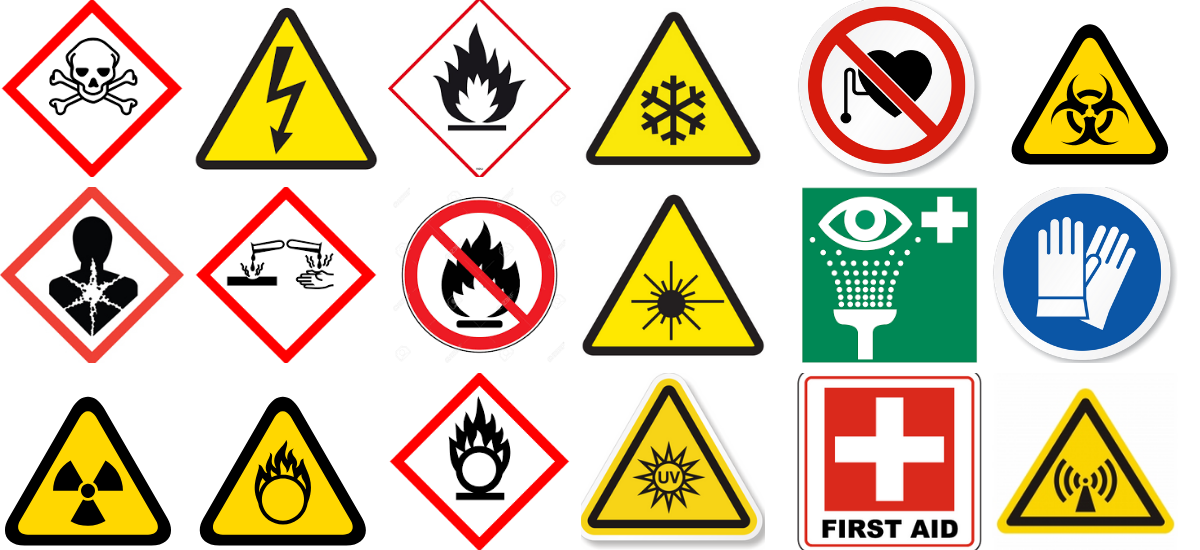
Chemicals and equipment are labelled with standard hazard symbols (warning pictograms) so that a danger can be recognised at a glance, even before reading the label in full. Diamond-shaped symbols with a red outline warn of a chemical hazard (e.g. toxic, corrosive, oxidising, explosive); yellow triangles warn of a physical danger (e.g. electric shock, flammable, laser); circular symbols show a mandatory action (e.g. wear gloves) or a prohibition (e.g. no naked flames); and green or red rectangles show the location of safety equipment (e.g. eyewash station, first aid kit).
Key laboratory safety rules:
Laboratory dos and don'ts
- Do wear safety goggles/eye protection whenever handling chemicals or heating substances
- Do tie back long hair and avoid loose clothing or sleeves near an open flame
- Do read chemical labels and check hazard symbols before use
- Do report spills, breakages, and injuries to the teacher immediately
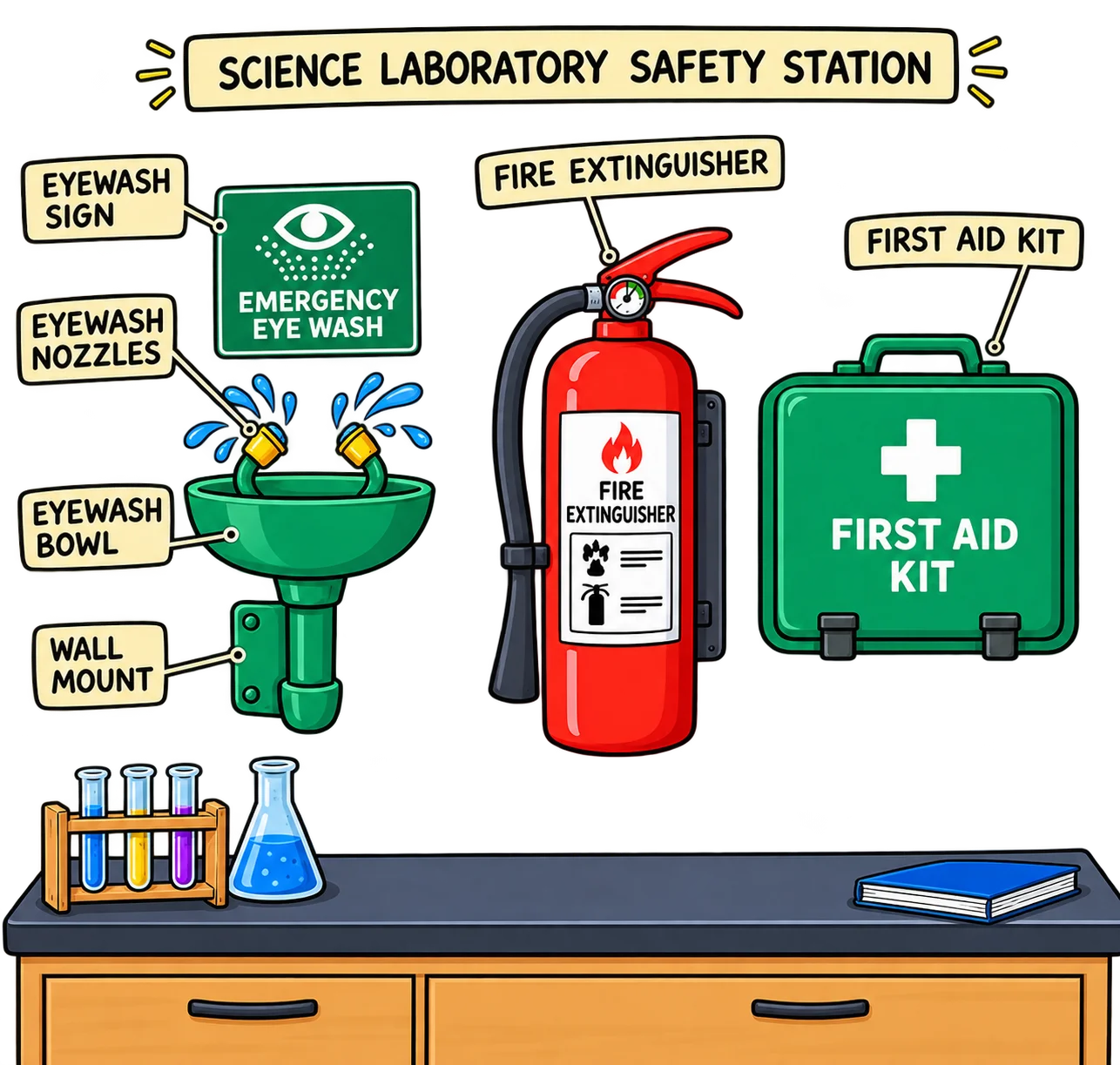
- Do know the location of the fire extinguisher, fire blanket, eyewash station, and first aid kit before starting practical work
- Do point test tubes being heated away from yourself and others
- Don't taste, smell directly, or touch chemicals with bare hands
- Don't eat, drink, or run in the laboratory
- Don't point the open end of a heated test tube at anyone
- Don't return unused chemicals to their original container (this risks contaminating the whole stock)
- Don't work in the laboratory unsupervised or without permission
Lesson 3: Measurements
Measurement is the process of comparing a quantity to a standard unit. Scientists use the SI system (International System of Units) for consistency across the world.
| Quantity | SI Unit | Symbol | Instrument |
|---|---|---|---|
| Length | metre | m | Ruler, metre rule, tape measure |
| Mass | kilogram | kg | Balance (beam or electronic) |
| Time | second | s | Stopwatch, clock |
| Temperature | degree Celsius | °C | Thermometer |
| Volume | cubic metre / litre | m³ / l | Measuring cylinder, burette |
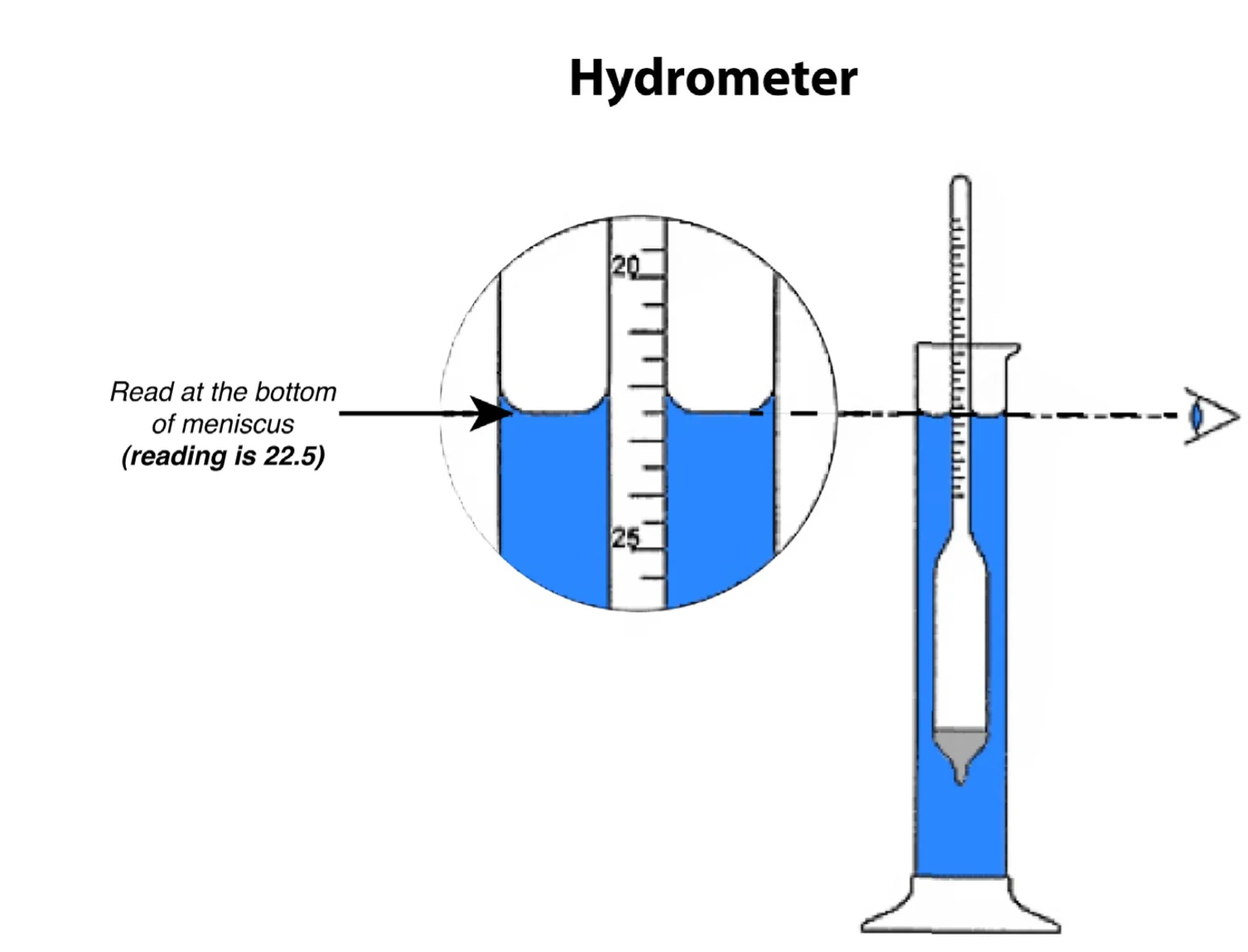
When reading a measuring cylinder containing a liquid, always read the meniscus (the curved surface of the liquid) at eye level, taking the reading from the bottom of the curve for most liquids.
Accuracy describes how close a measurement is to the true value. Precision describes how consistent repeated measurements are with each other, whether or not they are accurate.
Example: A student weighs the same 100g standard mass five times on a faulty balance and gets 92g, 93g, 92g, 93g, 92g. These results are precise (very consistent with each other) but not accurate (all far from the true value of 100g) — showing the balance itself needs recalibrating, since the student's technique is clearly consistent.
Accuracy vs precision: don't mix them up
- Accurate = close to the TRUE value
- Precise = repeated measurements are close to EACH OTHER (consistent), regardless of whether they're correct
- A measurement can be precise but not accurate (consistently wrong), accurate but not precise (right on average, but scattered), both, or neither
- Best practice in any experiment: take repeated measurements and calculate an average, which improves reliability
Scalars and vectors
Every quantity measured in science is either a scalar or a vector. A scalar quantity has magnitude (size) only — a number and a unit is all that's needed to describe it fully. A vector quantity has both magnitude and direction — giving the size alone is not enough to describe it fully.
| Scalars (magnitude only) | Vectors (magnitude + direction) |
|---|---|
| Length, distance | Displacement |
| Mass | Weight |
| Time | Force |
| Temperature | Velocity |
| Speed | Acceleration |
| Volume, area | Momentum |
Example: saying a car travels "60 km/h" describes its speed (a scalar). Saying it travels "60 km/h due north" describes its velocity (a vector) — the direction makes it a different kind of quantity. Vectors are often drawn as arrows, where the length of the arrow represents the magnitude and the way it points represents the direction.
Measuring area
Area is the amount of surface a two-dimensional shape covers, measured in square units (e.g. cm², m²). For regular shapes, area is found using a formula:
| Shape | Formula |
|---|---|
| Rectangle/square | Area = length × width |
| Triangle | Area = ½ × base × height |
| Circle | Area = π × radius² |
Area = length × width = 120 × 50 = 6 000 cm²
For an irregular shape (one with no simple formula, e.g. a leaf), area is estimated by placing the shape on graph paper (a grid): count every full square the shape covers, then count part-squares as roughly a half each, and add the totals together.
Measuring volume
Volume is the amount of space a three-dimensional object occupies, measured in cm³ or m³ (or litres for liquids). A regular solid's volume is found with a formula:
| Shape | Formula |
|---|---|
| Cube/cuboid | Volume = length × width × height |
| Cylinder | Volume = π × radius² × height |
Volume = length × width × height = 5 × 4 × 3 = 60 cm³
The volume of an irregular solid (e.g. a stone) that sinks in water is found by the displacement method: partly fill a measuring cylinder with water and record the level; lower the object in on a thread until fully submerged; record the new, higher level; the difference between the two readings is the volume of the object.
Volume of stone = final reading − initial reading = 72 − 50 = 22 cm³
Lesson 4: Mass, Density, Temperature and Time
Mass is the amount of matter in an object, measured in kilograms (kg) or grams (g), using a balance. Mass does not change with location.
Density is a measure of how much mass is packed into a given volume: Density = Mass ÷ Volume, usually measured in g/cm³ or kg/m³.
Density = Mass ÷ Volume = 150 ÷ 50 = 3 g/cm³
Rearranging Density = Mass ÷ Volume gives: Volume = Mass ÷ Density
Volume = 200 ÷ 8 = 25 cm³
Measuring the density of a liquid
A liquid's density can be found the same way as a solid's — Density = Mass ÷ Volume — by weighing an empty measuring cylinder, pouring in a known volume of the liquid, weighing again, and subtracting to find the mass of just the liquid. A quicker way is to use a hydrometer: a sealed, weighted floating tube with a calibrated scale that is lowered into the liquid and left to float freely; the depth to which it sinks depends on the liquid's density, and the density is read directly off the scale at the liquid's surface.
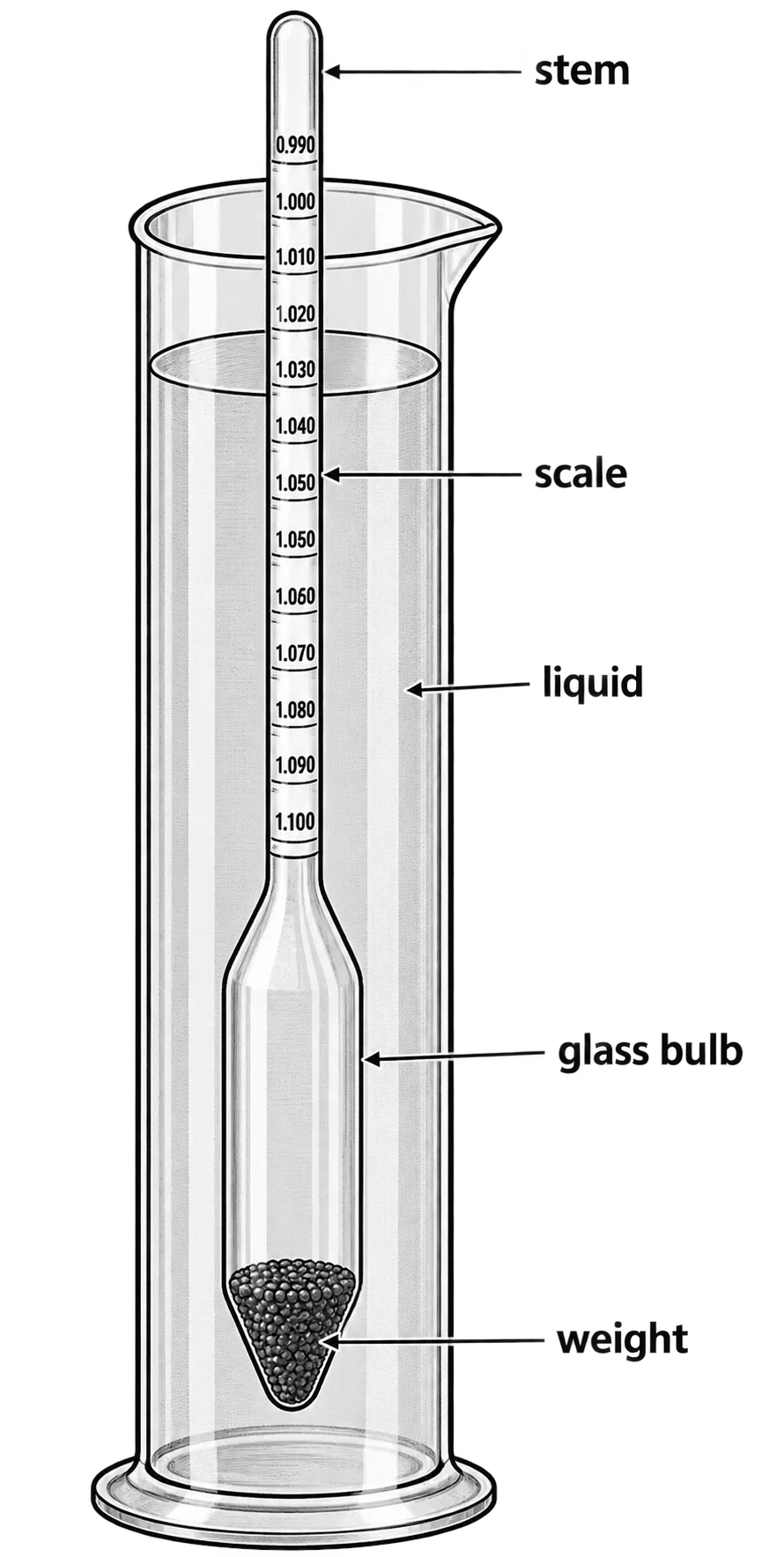
A hydrometer floats higher (less of it submerged) in a denser liquid, and sinks lower (more of it submerged) in a less dense liquid — the same reason an object floats more easily in salty seawater than in fresh water. The scale is printed upside down (larger density values lower down the stem) so that the reading is taken where the liquid surface crosses the stem.
Density and buoyancy
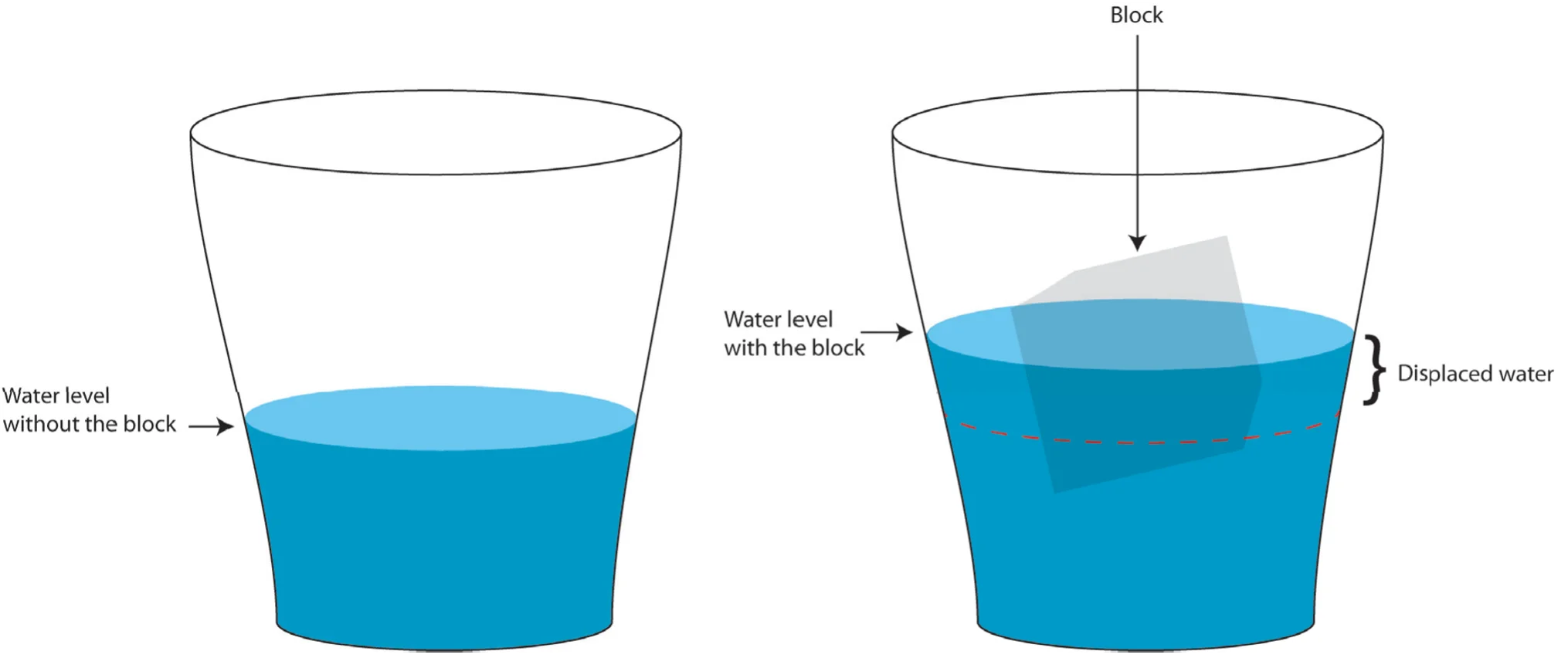
Objects with a density greater than water (1 g/cm³) sink in water; objects with a density less than water float. This happens because of upthrust — an upward force exerted by a fluid (liquid or gas) on any object placed in it, caused by the fluid pushing back against the object. Buoyancy is an object's tendency to float, and depends on how the object's density compares with the density of the fluid it is in.
An object floats when the upthrust acting on it is equal to its weight; it sinks when its weight is greater than the maximum upthrust the fluid can provide. This is why a solid steel block sinks, yet a steel ship (whose overall shape displaces a much larger volume of water, most of it air-filled space) floats — its average density, spread over the whole hull shape, is less than that of water.
Measuring temperature
Temperature measures how hot or cold something is. Temperature is different from heat: heat is a form of energy that flows from a hotter object to a colder one, while temperature measures the average energy of the particles in a substance.
The SI unit of temperature is the kelvin (K). Two other commonly used units are the degree Celsius (°C) and the degree Fahrenheit (°F). All three scales measure the same thing, just with different zero points and different-sized degrees.
| Scale | Freezing point of water | Boiling point of water |
|---|---|---|
| Kelvin (K) | 273 K | 373 K |
| Celsius (°C) | 0 °C | 100 °C |
| Fahrenheit (°F) | 32 °F | 212 °F |
Conversions between the scales:
| Conversion | Formula |
|---|---|
| Celsius → Kelvin | K = °C + 273 |
| Kelvin → Celsius | °C = K − 273 |
| Celsius → Fahrenheit | °F = (°C × 9⁄5) + 32 |
| Fahrenheit → Celsius | °C = (°F − 32) × 5⁄9 |
K = °C + 273 = 37 + 273 = 310 K
°F = (°C × 9⁄5) + 32 = (100 × 9⁄5) + 32 = 180 + 32 = 212 °F
°C = (°F − 32) × 5⁄9 = (98.6 − 32) × 5⁄9 = 66.6 × 5⁄9 = 37 °C
Laboratory vs clinical thermometers
A laboratory thermometer and a clinical thermometer are both mercury/liquid-in-glass thermometers, but are designed for very different jobs:
| Laboratory thermometer | Clinical thermometer | |
|---|---|---|
| Range | Wide, e.g. −10 °C to 110 °C | Narrow, e.g. 35 °C to 42 °C (around body temperature) |
| Purpose | General experiments — boiling, freezing, reaction temperatures | Measuring human body temperature only |
| Precision | Coarser graduations, e.g. every 1 °C | Fine graduations, e.g. every 0.1 °C, for small but important changes |
| Constriction (kink) | None — the liquid flows freely back down as it cools | Has a narrow constriction just above the bulb |
The clinical thermometer's constriction is a deliberate narrowing of the tube just above the bulb. As the thermometer heats up in the patient's mouth or armpit, the liquid expands past the constriction; but once removed from the body and cooling, the liquid column breaks at the constriction and cannot flow back down, so the reading stays fixed long enough to be read accurately. Before reuse, the thermometer must be firmly shaken (or reset electronically) to force the liquid back down past the constriction.
Thermometers with small vs large bulbs
The size of a thermometer's bulb affects how it responds to temperature changes. A large bulb holds more liquid, so it produces a bigger, easier-to-read expansion for a given temperature change (more sensitive) — but it also takes longer to heat up or cool down to match its surroundings, giving a slower response time. A small bulb holds less liquid, so it heats up and cools down quickly, giving a faster response time — useful for measuring temperatures that change rapidly, even though each individual reading may be slightly less sensitive.
Measuring time
Time is measured in seconds (s), the SI unit, using a stopwatch, stopclock, or ticker-timer, and is often used together with distance to calculate speed in scientific investigations. A digital stopwatch is generally more precise than an analogue one, often reading to 0.01 s.
Sources of error when timing an event by hand include:
Why timing by hand is unreliable
- Reaction time — the short delay (roughly 0.2–0.3 s) between seeing an event start or finish and pressing the stopwatch button, which affects both the start and the stop of the timing
- Parallax error — misreading a stopwatch or clock face because it is viewed from an angle rather than straight on
- Zero error — a stopwatch that doesn't start exactly at zero, or a clock that runs fast or slow
Reaction time error can be reduced by timing multiple repeats and taking an average, or — better still — by timing several repetitions of a short event together and dividing by the number of repetitions.
Time for one swing = total time ÷ number of swings = 30 ÷ 20 = 1.5 s
Any reaction-time error in starting and stopping the stopwatch is now spread across 20 swings instead of 1, making the result far more reliable.
When no timing device is available, time can be roughly estimated using a known steady rhythm, such as counting seconds aloud ("one-Mississippi, two-Mississippi…"), counting a resting heartbeat (about 1 beat per second, or roughly 70–80 beats per minute in an adult), or comparing against a familiar recurring event, such as how long a traffic light usually stays red. Estimated time is far less reliable than a measured time and should only be used when no timing instrument is available.
Lesson 5: Information and Communication Technology (ICT)
ICT refers to technologies used to store, process, retrieve, and communicate information, including computers, mobile phones, the internet, and software applications.
ICT plays an important role in science and everyday life: data logging uses sensors and computers to automatically record scientific measurements over time (e.g. temperature or light levels); simulations allow scientists to model processes that would be too dangerous, slow, or expensive to test in real life; and databases and the internet allow scientific information to be shared and accessed quickly worldwide.
Uses of ICT in Botswana include mobile banking, e-learning platforms, weather forecasting systems, and electronic health records in hospitals and clinics.
Responsible use of ICT includes protecting personal information, verifying the reliability of online sources, and being aware of risks such as cyberbullying and the spread of false information.
Media for communicating scientific knowledge
Scientific knowledge is shared through a range of media, each suited to a different audience and purpose:
| Medium | Typical use |
|---|---|
| Scientific journals & papers | Detailed, peer-reviewed findings shared between scientists |
| Textbooks & encyclopaedias | Established, well-tested knowledge for learners |
| Television & radio | Documentaries and news reaching a broad public audience |
| Internet & social media | Fast, wide-reaching, but of very mixed reliability |
| Conferences & presentations | Scientists sharing new findings directly with peers |
Peer review — where other scientists check a study's methods and conclusions before it is published — is what makes a scientific journal more trustworthy than an unchecked social media post, even though both may reach the public through the internet.
The impact of technology on society
Technology developed from scientific knowledge has transformed how people live and work. Positive impacts include improved healthcare (vaccines, diagnostic scanners, mobile clinics), increased farming yields (irrigation technology, fertilisers, weather forecasting), faster communication and transport, and access to information and education through computers and mobile devices.
Technology can also bring negative impacts: job losses where automation replaces manual labour, environmental damage from industrial processes and e-waste, overreliance on technology, and unequal access between those who can afford new technology and those who cannot (the digital divide).
Cultural impact of global communication
Global communication technology (the internet, satellite television, mobile phones) has connected cultures worldwide, allowing ideas, languages, music, and traditions to spread and be shared far beyond their place of origin. In Botswana, this has meant greater exposure to global trends and knowledge, alongside the ability to share Setswana culture and languages with the rest of the world.
This exchange has both benefits (learning from other cultures, international collaboration in science, cultural exchange and tourism) and risks (smaller or minority cultures and languages being overshadowed by dominant global media, and the spread of misinformation across borders faster than it can be checked).
Careers in ICT
The growth of ICT has created a wide range of careers, including: software developer (designing and writing computer programs and apps), network engineer (building and maintaining computer networks and internet connections), data analyst (interpreting large sets of data to find patterns and inform decisions), cybersecurity specialist (protecting computer systems and data from unauthorised access), and ICT technician (installing, maintaining, and repairing computer hardware and software). These careers are increasingly in demand in Botswana as government, schools, banks, and businesses continue to digitise their services.
Topic 2
Living Things & the Environment
There's more where that came from ✨
Subscribe and get everything, for every topic:
Topic 3
Materials & their Properties
There's more where that came from ✨
Subscribe and get everything, for every topic:
Topic 4
Sexual Reproductive Health
There's more where that came from ✨
Subscribe and get everything, for every topic:
Topic 5
Forces and Energy
There's more where that came from ✨
Subscribe and get everything, for every topic:
Topic 6
Forces, Motion and Energy
There's more where that came from ✨
Subscribe and get everything, for every topic:
Topic 7
Health and Safety
There's more where that came from ✨
Subscribe and get everything, for every topic:
Topic 8
The Human Body
There's more where that came from ✨
Subscribe and get everything, for every topic:
Topic 9
Electricity and Magnetism
There's more where that came from ✨
Subscribe and get everything, for every topic: